
How to Implement Software Defined Wide Area Network in NS3
To stimulate a Software-Defined Wide Area Network (SD-WAN) project using NS3 tool contains the replicate a SDN-based WAN where network control and data planes are decoupled. SD-WAN projects concentrate the centralized network management, dynamic path collection, and QoS enhancements for WANs.
Below is a step-by-step guide to help you start your SD-WAN project in NS3:
Steps to Begin Implementing a Software Defined Wide Area Network Projects Using NS3
- Understand SD-WAN Concepts
- Key Components:
- SD-WAN Controller: Centralized management for network paths, policies, and settings.
- Edge Routers: Sending the congestion among local and remote networks.
- Links: WAN connections among the geographically distributed places.
- Key Features:
- Dynamic path collection and load balancing.
- Execution for centralized policy.
- Improved the performance by QoS.
- Set up NS3 Environment
- Download and install NS3.
- Install further collections are required the specific SDN/SD-WAN capabilities for sample OpenFlow support.
- Familiarize yourself with NS3 modules:
- Internet Module: Intended for routing and TCP/IP communication.
- PointToPoint Module: Designed for the replicate a WAN connection.
- Applications Module: Aimed at the create congestion.
- Define Project Objectives
- Simulate scenarios such as:
- Path optimization among several sites.
- Bandwidth management and QoS implementation.
- Failover and recovery by resilient routing.
- Design the SD-WAN Topology
- Nodes:
- It replicates the branch sites, data centers for the SD-WAN controller.
- Links:
- It links the branch sites through Point-to-Point connection for replicate the WAN networks.
- Traffic:
- Create an application connection such as file transfers, video streaming, or VoIP.
- Basic Example Simulation
Here’s an sample of a simple for SD-WAN replication by centralized controller:
#include “ns3/core-module.h”
#include “ns3/network-module.h”
#include “ns3/internet-module.h”
#include “ns3/point-to-point-module.h”
#include “ns3/applications-module.h”
using namespace ns3;
int main(int argc, char *argv[]) {
CommandLine cmd;
cmd.Parse(argc, argv);
// Create nodes
NodeContainer branchSites, dataCenters, controller;
branchSites.Create(3); // Three branch sites
dataCenters.Create(1); // One data center
controller.Create(1); // SD-WAN controller
// Set up Point-to-Point links
PointToPointHelper p2p;
p2p.SetDeviceAttribute(“DataRate”, StringValue(“10Mbps”));
p2p.SetChannelAttribute(“Delay”, StringValue(“20ms”));
// Connect branches to data center
NetDeviceContainer branchToDcDevices;
for (uint32_t i = 0; i < branchSites.GetN(); ++i) {
branchToDcDevices.Add(p2p.Install(branchSites.Get(i), dataCenters.Get(0)));
}
// Connect SD-WAN controller to data center
NetDeviceContainer controllerToDcDevices = p2p.Install(controller.Get(0), dataCenters.Get(0)));
// Install Internet stack
InternetStackHelper stack;
stack.Install(branchSites);
stack.Install(dataCenters);
stack.Install(controller);
// Assign IP addresses
Ipv4AddressHelper ipv4;
ipv4.SetBase(“10.1.1.0”, “255.255.255.0”);
ipv4.Assign(branchToDcDevices);
ipv4.SetBase(“10.1.2.0”, “255.255.255.0”);
ipv4.Assign(controllerToDcDevices);
// Simulate SD-WAN controller as a traffic manager
uint16_t port = 8080;
PacketSinkHelper controllerSink(“ns3::TcpSocketFactory”, InetSocketAddress(Ipv4Address::GetAny(), port));
ApplicationContainer controllerApp = controllerSink.Install(controller.Get(0));
controllerApp.Start(Seconds(1.0));
controllerApp.Stop(Seconds(10.0));
// Generate traffic from branch to data center
OnOffHelper trafficGen(“ns3::TcpSocketFactory”, InetSocketAddress(Ipv4Address(“10.1.1.1”), port));
trafficGen.SetAttribute(“DataRate”, StringValue(“5Mbps”));
trafficGen.SetAttribute(“PacketSize”, UintegerValue(1024));
for (uint32_t i = 0; i < branchSites.GetN(); ++i) {
ApplicationContainer branchApp = trafficGen.Install(branchSites.Get(i));
branchApp.Start(Seconds(2.0));
branchApp.Stop(Seconds(9.0));
}
Simulator::Run();
Simulator::Destroy();
return 0;
}
- Enhance the Simulation
- SDN Functionality:
- Incorporate an SDN controller using OpenFlow collection for dynamically handle network paths.
- QoS Policies:
- Apply the traffic prioritization and bandwidth assign for detailed applications.
- Multi-Path Routing:
- It replicates the several WAN connections for improved the dynamically congestion flow.
- Performance Metrics
- Latency:
- It calculate the delay among branches for the data center.
- Throughput:
- Estimate the data transmission rates for several congestion flows.
- Packet Loss:
- Examine the reliability for below the various network environments.
- Link Utilization:
- It tracks the usage of WAN connections.
- Advanced Features
- Dynamic Path Selection:
- Apply the procedures for the switch paths according to their connection of performance such as latency, bandwidth.
- Load Balancing:
- It replicates the environment that congestion is distributed with several connections.
- Failure Recovery:
- Establish the connection failures for validate the failover mechanisms.
- Security:
- Enhance encode or firewall rules for secure the congestion of SD-WAN.
- Visualization and Analysis
- Use the tool like NetAnim for envisions the congestion flows and topology communications.
- Study the replication of outcomes using Python or MATLAB for specific performance graphs.
- Extensions
- Hybrid WAN:
- It replicates the environment by a mix of MPLS, broadband, and LTE connection.
- IoT Integration:
- Enhance the IoT devices communicating through SD-WAN for replicate the real-world deployments.
- Energy Efficiency:
- Examine the power usage in SD-WAN networks.
- Integration with MEC (Mobile Edge Computing):
- It incorporates the offload congestion for edge nodes in low-latency processing.
In the above procedures demonstrated the complete procedures to implement and enforce the Software-Defined Wide Area Network in ns3 simulation tool that is efficiently used to handle the network. Additional specific details regarding the SDWAN will also be provided.
 Click Here to watch our latest output video using NS3 simulator
 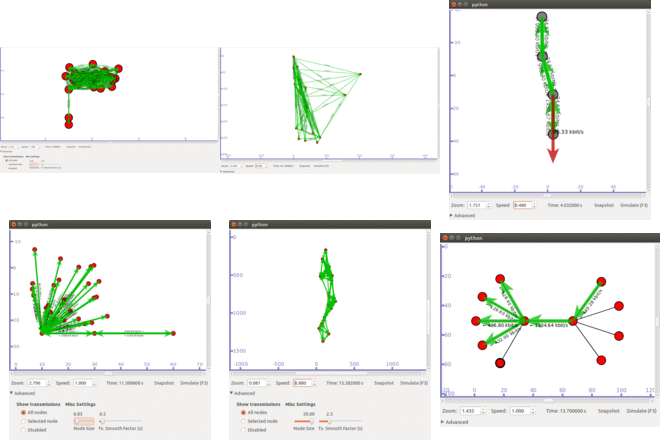 Click Here to watch our latest projects screenshots using NS3 simulator