
How to Begin Implementing a Telecommunication in NS3
To begin executing a Telecommunication project in NS3 that has replicating the communication systems, protocols, and network behaviors within a controlled environment. Here’s a common procedure to get started with telecommunication project:
Steps to Begin Implementing Telecommunication Projects in NS3
Step 1: Understand Project Requirements
- Identify the Use Case:
- Following is a requirements of telecommunication project like:
- Optical communication.
- VoIP or multimedia transmission.
- QoS and performance analysis.
- Cellular networks (LTE, 5G).
- Packet-switched networks.
- Following is a requirements of telecommunication project like:
- Understand the Scope:
- Focus on the essential projects objectives:
- Network design and deployment.
- Protocol estimation or development.
- Performance parameters analysis.
- Focus on the essential projects objectives:
- Learn NS3 Basics:
- Study architecture, modules, and scripting capabilities of NS3 utilising C++ or Python programming.
- Execute simple instance of NS3 for knowing their functioning properly.
Step 2: Prepare the Environment
- Install NS3:
- We should download and set up NS3 on the system.
- Install necessary dependencies such as gcc, g++, Python, and other tools.
- Set Up Development Tools:
- For code editing, we can utilise an IDE or text editor such as VSCode or Eclipse.
- Set up visualization tools like NetAnim or PyViz.
- Enable Specific Modules:
- During installation, make certain that essential certain components in terms of LTE, WiFi, and CSMA are contained.
Step 3: Design the Telecommunication System
- Define the Network Topology:
- We can make network topology with star, mesh, tree, or custom.
- Describe the types and volume of nodes:
- Mobile users, base stations, core network nodes.
- Select Communication Technologies:
- We need to decide on the communication technologies such as LTE, 5G, WiFi, Optical networks, or custom protocols.
- Protocol stack like TCP/IP or specialized telecommunication protocols.
- Traffic Generation:
- Select the kind of traffic such as voice, video, data and traffic models.
- Performance Metrics:
- We can estimate the performance parameters like throughput, latency, jitter, and packet loss.
Step 4: Implement the Telecommunication Project
- Create Nodes:
- Describe network nodes to utilise NodeContainer.
- Install Communication Devices:
- We want to install network devices with the support of proper device helpers such as LteHelper, WifiHelper, CsmaHelper, and so on.
- Configure Mobility:
- Replicate node movement to leverage MobilityHelper for mobile communication.
- Traffic Simulation:
- Make applications that generating traffic flows like UDP/TCP or custom applications with the help of ApplicationHelper.
- Set Up Protocols:
- Set up routing protocols or execute a custom protocol.
- For instance: Ad-hoc routing (AODV) or LTE Evolved Packet Core (EPC).
- Simulate QoS or Resource Allocation:
- Execute the QoS strategies or resource allocation approaches.
- Enable Tracing:
- We should exploit NS3’s tracing aspects such as AsciiTrace, PcapTrace, FlowMonitor for in-depth logging.
Step 5: Test and Optimize
- Run Simulations:
- We can begin with small-scale simulations for authenticate functionality.
- Progressively increase to more complex networks.
- Analyze Metrics:
- Estimate the performance indicators such as throughput, latency, jitter, and packet delivery ratio.
- Detect and determine the blockages or inefficiencies.
- Fine-Tune Parameters:
- Fine-tune network metrics in terms of bandwidth, buffer size, and scheduling strategies.
Step 6: Visualize and Analyze
- Visualize Network Behavior:
- For real-time visualization of node communications, we need to utilise the tools like NetAnim or PyViz.
- Analyze Data:
- Transfer simulation outcomes and then examine them with the support of Python (Matplotlib), MATLAB, or Excel.
Step 7: Document and Present
- Document Implementation:
- Log all sets up, procedures, and outcomes.
- Prepare Visualizations:
- Successfully demonstrate outcomes to exploit graphs, charts, and tables.
- Write a Report:
- The project should have goals, mechanisms, results, and conclusions.
Example Telecommunication Project
Simulating LTE Communication
#include “ns3/core-module.h”
#include “ns3/mobility-module.h”
#include “ns3/lte-module.h”
#include “ns3/internet-module.h”
using namespace ns3;
int main(int argc, char *argv[]) {
// Step 1: Create nodes
NodeContainer ueNodes, enbNodes;
ueNodes.Create(10); // 10 User Equipments (UEs)
enbNodes.Create(2); // 2 Base Stations (eNBs)
// Step 2: Set mobility
MobilityHelper mobility;
mobility.SetMobilityModel(“ns3::RandomWalk2dMobilityModel”);
mobility.Install(ueNodes);
mobility.SetMobilityModel(“ns3::ConstantPositionMobilityModel”);
mobility.Install(enbNodes);
// Step 3: Configure LTE devices
Ptr<LteHelper> lteHelper = CreateObject<LteHelper>();
NetDeviceContainer enbDevices = lteHelper->InstallEnbDevice(enbNodes);
NetDeviceContainer ueDevices = lteHelper->InstallUeDevice(ueNodes);
// Step 4: Install Internet stack
InternetStackHelper internet;
internet.Install(ueNodes);
// Step 5: Assign IP addresses
Ipv4InterfaceContainer ueIpIface;
ueIpIface = lteHelper->AssignUeIpv4Address(NetDeviceContainer(ueDevices));
// Step 6: Attach UEs to eNBs
for (uint32_t i = 0; i < ueNodes.GetN(); ++i) {
lteHelper->Attach(ueDevices.Get(i), enbDevices.Get(0)); // Attach to eNB 0
}
// Step 7: Simulate traffic
Simulator::Stop(Seconds(20.0));
Simulator::Run();
Simulator::Destroy();
return 0;
}
Ideas for Telecommunication Projects
- LTE/5G Network Optimization:
- Replicate and examine the resource allocation and QoS performance.
- VoIP over LTE:
- Examine voice and video transmission quality within LTE networks.
- Handover Management:
- Focus on handover situations among the base stations including mobile UEs.
- Interference Mitigation:
- Mimic interference management mechanisms in compactly populated networks.
- Ad-hoc Networks:
- Execute and estimate the Ad-hoc networks with routing protocols such as AODV or DSR.
Additional Resources
- NS3 Modules:
- LTE, WiFi, CSMA, and Internet components of NS3.
- For in-depth performance analysis, we want to utilise FlowMonitor.
- Visualization:
- NetAnim for node envision.
- Python (Matplotlib) or MATLAB are used for graphing result.
- Research Papers:
- Learn research papers for knowing the concepts, techniques and predicted outcomes on same projects.
This setup demonstrates a simple implementation of Telecommunication Projects in NS3 environment using sample coding for simulating LTE communication. You can expand it further that contains more specifies and advanced methodology as needed.
 Click Here to watch our latest output video using NS3 simulator
 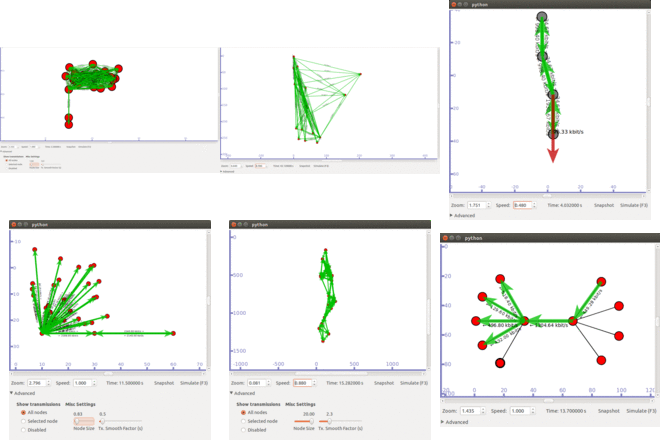 Click Here to watch our latest projects screenshots using NS3 simulator