
How to Begin Implementing a Network Routing projects using ns3
To stimulate a Network Routing project in ns-3 contains the replicate on how well the data packets are routed with network using fixed or dynamic routing protocols. Below is a step-by-step guide to help you get started.
Steps to Begin Implementing a Network Routing projects using ns3
Step 1: Understand Network Routing Concepts
- Routing Protocols:
- Static Routing: The static routing has Predefined routes, no adaptation for modify the topology.
- Dynamic Routing:
- Proactive: It handles the routing tables for sample OSPF, DSDV.
- Reactive: It detects the routes on demand for instance AODV, DSR.
- Routing Scenarios:
- Wired networks: Use the wired network protocols such as RIP, OSPF.
- Wireless networks: Use the wireless networks protocols like AODV, DSDV.
- Key Metrics:
- It offers the performance the metrices like as end-to-end delay, packet delivery ratio, throughput, routing overhead.
Step 2: Install ns-3 and Required Modules
- Download ns-3:
- Install the latest version from nsnam.org.
- Enable Required Modules:
- Involves the components for replicate the routing network:
./waf configure –enable-modules=internet,ipv4-routing,manet-routing,mobility,wifi,point-to-point
./waf build
- Verify Installation:
- Validate the sample scripts for routing protocols:
./waf –run aodv
./waf –run dsdv
Step 3: Define the Project Scope
- Scenario:
- The network topology consist the static or dynamic topology.
- The routing protocol for Wired or wireless communication.
- Goals:
- It associates the performance of routing protocols.
- Execute and estimate the custom routing protocol.
- Metrics:
- The performance metrices such as Packet delivery ratio (PDR), latency, throughput, routing overhead.
Step : Set Up Network Topology
- Create Nodes:
- Express the nodes for the network:
NodeContainer nodes;
nodes.Create(5); // 5 nodes in the network
- Set Up Links:
- Use the setting for Point-to-Point (wired) or WiFi (wireless) connection:
PointToPointHelper p2p;
p2p.SetDeviceAttribute(“DataRate”, StringValue(“1Gbps”));
p2p.SetChannelAttribute(“Delay”, StringValue(“2ms”));
NetDeviceContainer devices = p2p.Install(nodes.Get(0), nodes.Get(1));
- Configure Mobility (For Wireless):
- Configure the mobility for dynamic topologies:
MobilityHelper mobility;
mobility.SetMobilityModel(“ns3::RandomWalk2dMobilityModel”,
“Bounds”, RectangleValue(Rectangle(-100, 100, -100, 100)));
mobility.Install(nodes);
Step 5: Install Routing Protocols
- Static Routing:
- Manually describe the routes:
Ipv4StaticRoutingHelper staticRoutingHelper;
Ptr<Ipv4StaticRouting> staticRouting = staticRoutingHelper.GetStaticRouting(nodes.Get(0)->GetObject<Ipv4>());
staticRouting->AddHostRouteTo(Ipv4Address(“10.1.1.2”), Ipv4Address(“10.1.1.1”), 1);
- Dynamic Routing:
- It use the built-in dynamic routing protocols:
AodvHelper aodv;
InternetStackHelper stack;
stack.SetRoutingHelper(aodv); // Use AODV for routing
stack.Install(nodes);
- Routing Table Verification:
- Design the routing tables for enable they are setting correctly:
Ipv4GlobalRoutingHelper::PopulateRoutingTables();
Step 6: Assign IP Addresses
- Allocate the IP addresses for devices:
InternetStackHelper stack;
stack.Install(nodes);
Ipv4AddressHelper ipv4;
ipv4.SetBase(“10.1.1.0”, “255.255.255.0”);
Ipv4InterfaceContainer interfaces = ipv4.Assign(devices);
Step 7: Add Traffic Applications
- Traffic Generators:
- Improve the application for build and receive congestion:
uint16_t port = 9;
Address sinkAddress(InetSocketAddress(interfaces.GetAddress(1), port));
PacketSinkHelper sink(“ns3::UdpSocketFactory”, sinkAddress);
ApplicationContainer sinkApp = sink.Install(nodes.Get(1));
sinkApp.Start(Seconds(1.0));
sinkApp.Stop(Seconds(10.0));
OnOffHelper onOff(“ns3::UdpSocketFactory”, sinkAddress);
onOff.SetAttribute(“DataRate”, StringValue(“500Kbps”));
ApplicationContainer clientApp = onOff.Install(nodes.Get(0));
clientApp.Start(Seconds(2.0));
clientApp.Stop(Seconds(10.0));
- Custom Applications:
- Encompass the Application for custom congestion design.
Step 8: Enable Tracing and Monitoring
- Enable Tracing:
- The performance of metrices actions for analysis:
AsciiTraceHelper ascii;
p2p.EnableAsciiAll(ascii.CreateFileStream(“routing.tr”));
- FlowMonitor:
- Use the FlowMonitor for performance metrics:
FlowMonitorHelper flowMonitor;
Ptr<FlowMonitor> monitor = flowMonitor.InstallAll();
Step 9: Run the Simulation
- Schedule Simulation:
- Describe the duration of replication:
Simulator::Stop(Seconds(10.0));
Simulator::Run();
Simulator::Destroy();
- Analyze Results:
- Use the outcomes for trace files or track the results in estimate the performance.
Step 10: Example: AODV in Wireless Network
Below is a basic sample script for executing AODV in a wireless network:
#include “ns3/core-module.h”
#include “ns3/network-module.h”
#include “ns3/mobility-module.h”
#include “ns3/wifi-module.h”
#include “ns3/aodv-helper.h”
#include “ns3/internet-module.h”
#include “ns3/applications-module.h”
using namespace ns3;
int main(int argc, char *argv[]) {
NodeContainer nodes;
nodes.Create(5);
MobilityHelper mobility;
mobility.SetMobilityModel(“ns3::ConstantPositionMobilityModel”);
mobility.Install(nodes);
YansWifiChannelHelper wifiChannel = YansWifiChannelHelper::Default();
YansWifiPhyHelper wifiPhy = YansWifiPhyHelper::Default();
wifiPhy.SetChannel(wifiChannel.Create());
WifiHelper wifi;
wifi.SetRemoteStationManager(“ns3::AarfWifiManager”);
WifiMacHelper wifiMac;
Ssid ssid = Ssid(“ns3-wifi”);
wifiMac.SetType(“ns3::AdhocWifiMac”);
NetDeviceContainer devices = wifi.Install(wifiPhy, wifiMac, nodes);
AodvHelper aodv;
InternetStackHelper stack;
stack.SetRoutingHelper(aodv);
stack.Install(nodes);
Ipv4AddressHelper ipv4;
ipv4.SetBase(“10.1.1.0”, “255.255.255.0”);
Ipv4InterfaceContainer interfaces = ipv4.Assign(devices);
uint16_t port = 9;
UdpEchoServerHelper server(port);
ApplicationContainer serverApp = server.Install(nodes.Get(4));
serverApp.Start(Seconds(1.0));
serverApp.Stop(Seconds(10.0));
UdpEchoClientHelper client(interfaces.GetAddress(4), port);
client.SetAttribute(“MaxPackets”, UintegerValue(100));
client.SetAttribute(“Interval”, TimeValue(Seconds(1.0)));
client.SetAttribute(“PacketSize”, UintegerValue(1024));
ApplicationContainer clientApp = client.Install(nodes.Get(0));
clientApp.Start(Seconds(2.0));
clientApp.Stop(Seconds(10.0));
Simulator::Stop(Seconds(10.0));
Simulator::Run();
Simulator::Destroy();
return 0;
}
Step 11: Extend and Customize
- Custom Protocols:
- Apply the new routing procedures through encompass the Ipv4RoutingProtocol.
- Performance Analysis:
- It associates the several routing protocols below the similar network environments.
- Complex Topologies:
- It replicates the large-scale networks by dynamic mobility.
We explicitly aggregated the significant information regarding the network routing that has generates a basic topology and creates traffic among nodes using the AODV routing protocol that execute in ns3 simulation. We will issue an additional document for questions related to this project.
 Click Here to watch our latest output video using NS3 simulator
 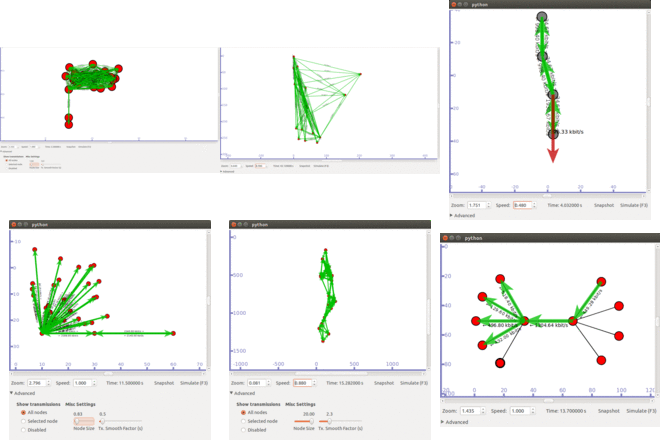 Click Here to watch our latest projects screenshots using NS3 simulator