
How to Begin Implement Network Transmission Speed in NS3
To implement and examine the Network Transmission Speed in ns-3, follow these steps. Network transmission speed are calculates the rate of that data is successfully has communicated from the sender to a receiver, frequently stated in bits per second (bps).
Steps to Begin Implement Network Transmission Speed in NS3
- Understand Transmission Speed
Transmission speed can be subjective through:
- Link bandwidth: The physical layer has helps through the maximum data rate.
- Packet size: Larger packets can affect the communication speed due to fragmentation or overhead.
- Latency: It contains the processing, queuing, and broadcast delays.
- Error rate and retransmissions: Improve the overhead and decrease the effective communication speed.
- Set up Your Environment
Assure the ns-3 is installed and functional. Use the suitable components such as Wi-Fi, Point-to-Point, or LTE according to their environment.
- Create a Network Topology
Example: Point-to-Point Network
NodeContainer nodes;
nodes.Create(2); // One sender and one receiver
PointToPointHelper pointToPoint;
pointToPoint.SetDeviceAttribute(“DataRate”, StringValue(“10Mbps”)); // Link bandwidth
pointToPoint.SetChannelAttribute(“Delay”, StringValue(“2ms”)); // Link delay
NetDeviceContainer devices = pointToPoint.Install(nodes);
- Set Up the Internet Stack
Install the Internet stack for IP-based communication:
InternetStackHelper stack;
stack.Install(nodes);
Ipv4AddressHelper address;
address.SetBase(“10.1.1.0”, “255.255.255.0”);
Ipv4InterfaceContainer interfaces = address.Assign(devices);
- Generate Traffic
for replicate the congestion install applications.
Example: UDP Traffic
UdpEchoServerHelper echoServer(9);
ApplicationContainer serverApps = echoServer.Install(nodes.Get(1)); // Receiver
serverApps.Start(Seconds(1.0));
serverApps.Stop(Seconds(10.0));
UdpEchoClientHelper echoClient(interfaces.GetAddress(1), 9);
echoClient.SetAttribute(“MaxPackets”, UintegerValue(1000));
echoClient.SetAttribute(“Interval”, TimeValue(Seconds(0.01))); // 10ms interval
echoClient.SetAttribute(“PacketSize”, UintegerValue(1024)); // 1KB packets
ApplicationContainer clientApps = echoClient.Install(nodes.Get(0)); // Sender
clientApps.Start(Seconds(2.0));
clientApps.Stop(Seconds(10.0));
- Measure Transmission Speed
FlowMonitor used to calculate the performance of transmission.
Install FlowMonitor
FlowMonitorHelper flowmon;
Ptr<FlowMonitor> monitor = flowmon.InstallAll();
Simulator::Stop(Seconds(10.0));
Simulator::Run();
monitor->CheckForLostPackets();
Ptr<Ipv4FlowClassifier> classifier = DynamicCast<Ipv4FlowClassifier>(flowmon.GetClassifier());
std::map<FlowId, FlowMonitor::FlowStats> stats = monitor->GetFlowStats();
for (auto& flow : stats) {
double throughput = flow.second.rxBytes * 8.0 / (flow.second.timeLastRxPacket.GetSeconds() – flow.second.timeFirstTxPacket.GetSeconds()); // bps
std::cout << “Flow ” << flow.first << ” Transmission Speed: ” << throughput / 1e6 << ” Mbps\n”;
}
- Track Sent and Received Packets
Use callbacks to log packets forward and received, and estimate the transmission speed manually.
Count Packets and Bytes
uint64_t bytesSent = 0, bytesReceived = 0;
void PacketSentCallback(Ptr<const Packet> packet) {
bytesSent += packet->GetSize();
}
void PacketReceivedCallback(Ptr<const Packet> packet) {
bytesReceived += packet->GetSize();
}
devices.Get(0)->TraceConnectWithoutContext(“MacTx”, MakeCallback(&PacketSentCallback));
devices.Get(1)->TraceConnectWithoutContext(“MacRx”, MakeCallback(&PacketReceivedCallback));
Calculate Transmission Speed
At the final replication of transmission speed:
Simulator::Schedule(Seconds(10.0), [] {
double transmissionSpeed = bytesReceived * 8.0 / 10.0; // bps (assuming 10s simulation time)
std::cout << “Transmission Speed: ” << transmissionSpeed / 1e6 << ” Mbps\n”;
});
- Enable Tracing
ASCII and PCAP Tracing
Log packet actions for further analysis:
AsciiTraceHelper ascii;
pointToPoint.EnableAsciiAll(ascii.CreateFileStream(“transmission_speed.tr”));
pointToPoint.EnablePcapAll(“transmission_speed”);
- Visualize Results
- Distribute the transmission speed data to MATLAB or Excel for graphing.
- Use to visualize packet transmission like as NetAnim:
AnimationInterface anim(“transmission_speed.xml”);
- Experiment with Parameters
- Bandwidth: Validate by modify the data rates for sample 1Mbps, 10Mbps.
- Packet Size: Designed for following the impact of increase or decrease the packet size.
- Traffic Load: It replicates the high congestion environment through decrease the packet interval.
- Error Models: It determine the error pattern to estimate the effect:
Ptr<RateErrorModel> errorModel = CreateObject<RateErrorModel>();
errorModel->SetAttribute(“ErrorRate”, DoubleValue(0.01)); // 1% error rate
devices.Get(1)->SetAttribute(“ReceiveErrorModel”, PointerValue(errorModel));
- Run the Simulation
It executes the outcomes for analysis:
Simulator::Run();
Simulator::Destroy();
We demonstrate how to calculate the network transmission speed in ns3 tool that has setup and configure the network model then apply the packet transmission logic then analyse the results. A secondary manual will provide answers to any further questions about this project
 Click Here to watch our latest output video using NS3 simulator
 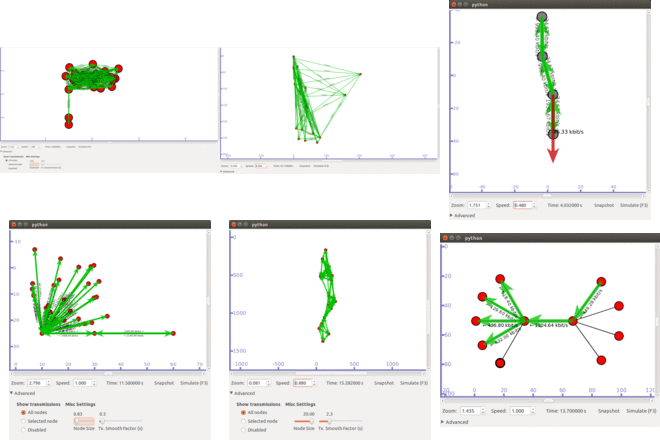 Click Here to watch our latest projects screenshots using NS3 simulator