
How to Begin Implement Network Power Consumption in NS3
To begin implementing and examining the Network Power Consumption using NS3, we need to follow provided stepwise approach:
Steps to Begin Implement Network Power Consumption in NS3
- Understand the Power Consumption Concept
In a network, power consumption based on:
- Idle and sleep states of network devices.
- Transmission power.
- Energy patterns are used for measuring the energy consumption.
- Applications are generating traffic and its operational models.
Energy Framework is leveraged for designing and examining the power consumption in ns3.
- Set Up Your Environment
- Make sure that we have installed ns3 on the computer.
- We can get more knowledge about Energy Framework using ns3, which is available in the Wi-Fi and LTE modules.
- Include Energy Models
In ns3, Energy Framework shows energy consumption for devices. It needs to:
- Energy Source: Provide energy to the device.
- Device Energy Model: Estimate the energy consumption.
For instance:
- BasicEnergySource: Designs an energy source of device.
- WifiRadioEnergyModel: Models energy expended by Wi-Fi devices.
- Define Network Nodes
Make network nodes and allocate them mobility:
NodeContainer nodes;
nodes.Create(10); // Create 10 nodes
MobilityHelper mobility;
mobility.SetPositionAllocator(“ns3::GridPositionAllocator”,
“MinX”, DoubleValue(0.0),
“MinY”, DoubleValue(0.0),
“DeltaX”, DoubleValue(50.0),
“DeltaY”, DoubleValue(50.0),
“GridWidth”, UintegerValue(3),
“LayoutType”, StringValue(“RowFirst”));
mobility.SetMobilityModel(“ns3::ConstantPositionMobilityModel”);
mobility.Install(nodes);
- Set Up Wi-Fi Communication
We can install Wi-Fi devices and protocols for communication:
WifiHelper wifi;
wifi.SetStandard(WIFI_PHY_STANDARD_80211n);
YansWifiPhyHelper phy = YansWifiPhyHelper::Default();
YansWifiChannelHelper channel = YansWifiChannelHelper::Default();
phy.SetChannel(channel.Create());
WifiMacHelper mac;
mac.SetType(“ns3::AdhocWifiMac”);
NetDeviceContainer devices = wifi.Install(phy, mac, nodes);
InternetStackHelper stack;
stack.Install(nodes);
Ipv4AddressHelper address;
address.SetBase(“10.1.1.0”, “255.255.255.0”);
Ipv4InterfaceContainer interfaces = address.Assign(devices);
- Add Energy Models
Add an energy source and a Wi-Fi energy model to every node:
BasicEnergySourceHelper energySourceHelper;
energySourceHelper.Set(“BasicEnergySourceInitialEnergyJ”, DoubleValue(100.0)); // Initial energy in Joules
WifiRadioEnergyModelHelper radioEnergyHelper;
radioEnergyHelper.Set(“TxCurrentA”, DoubleValue(0.017)); // Current in Amperes during transmission
radioEnergyHelper.Set(“RxCurrentA”, DoubleValue(0.013)); // Current in Amperes during reception
EnergySourceContainer energySources = energySourceHelper.Install(nodes);
DeviceEnergyModelContainer deviceModels = radioEnergyHelper.Install(devices, energySources);
- Install Applications
Integrate the applications for making network traffic:
UdpEchoServerHelper echoServer(9);
ApplicationContainer serverApps = echoServer.Install(nodes.Get(0));
serverApps.Start(Seconds(1.0));
serverApps.Stop(Seconds(10.0));
UdpEchoClientHelper echoClient(interfaces.GetAddress(0), 9);
echoClient.SetAttribute(“MaxPackets”, UintegerValue(100));
echoClient.SetAttribute(“Interval”, TimeValue(Seconds(0.01)));
echoClient.SetAttribute(“PacketSize”, UintegerValue(1024));
ApplicationContainer clientApps = echoClient.Install(nodes.Get(1));
clientApps.Start(Seconds(2.0));
clientApps.Stop(Seconds(10.0));
- Monitor Energy Consumption
During the simulation, observe the levels of energy:
Ptr<BasicEnergySource> source = DynamicCast<BasicEnergySource>(energySources.Get(0));
Simulator::Schedule(Seconds(5.0), &BasicEnergySource::UpdateEnergySource, source);
Simulator::Schedule(Seconds(5.0), &BasicEnergySource::GetRemainingEnergy, source);
source->TraceConnectWithoutContext(“RemainingEnergy”, MakeCallback(&PrintEnergy));
Example Callback to Print Energy Levels:
void PrintEnergy(double oldValue, double newValue) {
std::cout << “Remaining energy: ” << newValue << “J” << std::endl;
}
- Analyze and Visualize Results
- Log Energy Levels: Observe the energy utilization over time to apply tracing or custom callbacks.
- Visualize Results:
- Transfer energy information into files for visualization.
- Make use of ns3 tools such as Gnuplot for graphical representation.
- Experiment with Different Configurations
- Modify transmission power such as TxPowerStart, TxPowerEnd to learn energy utilization.
- Fine-tune node density and traffic models.
- Experiment other energy patterns such as DeviceEnergyModel for LTE or custom energy models.
- Run and Debug the Simulation
Finally, execute the simulation and confirm energy consumption models:
Simulator::Run();
Simulator::Destroy();
Detailed, sequential steps for implementing and examining the Network Power Consumption using NS3 environment have been offered. We’re ready to add more details and additional concepts, if necessary.
 Click Here to watch our latest output video using NS3 simulator
 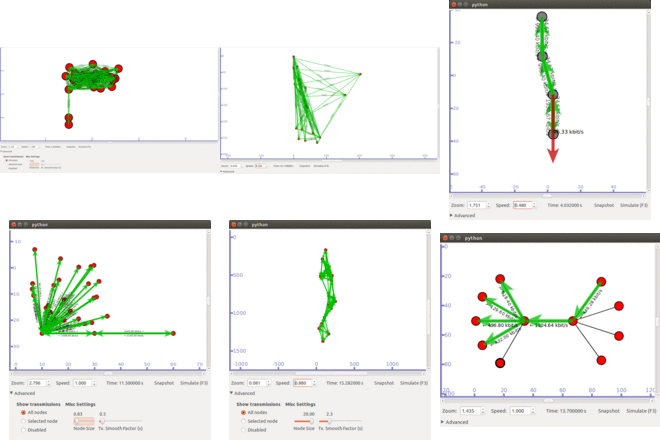 Click Here to watch our latest projects screenshots using NS3 simulator