
How to Begin Implement Network End to End Delay in NS3
To implement and study the Network End-to-End Delay in ns-3, follow these steps. End-to-End Delay is a performance of parameter metric which compute the duration for a packet to travel from the sender to the receiver with the network.
Steps to Begin Implement Network End to End Delay in NS3
- Understand End-to-End Delay
End-to-End Delay is computed as:
End-to-End Delay=Packet Arrival Time−Packet Sent Time\text{End-to-End Delay} = \text{Packet Arrival Time} – \text{Packet Sent Time}End-to-End Delay=Packet Arrival Time−Packet Sent Time
- Set up Your Environment
Assure the tool ns3 is install and setting. Familiarize by simple ns-3 scripting.
- Create the Network Topology
Example: Point-to-Point Network
NodeContainer nodes;
nodes.Create(2);
PointToPointHelper pointToPoint;
pointToPoint.SetDeviceAttribute(“DataRate”, StringValue(“10Mbps”));
pointToPoint.SetChannelAttribute(“Delay”, StringValue(“2ms”));
NetDeviceContainer devices;
devices = pointToPoint.Install(nodes);
Example: Wireless Network
YansWifiChannelHelper channel = YansWifiChannelHelper::Default();
YansWifiPhyHelper phy = YansWifiPhyHelper::Default();
phy.SetChannel(channel.Create());
WifiHelper wifi;
wifi.SetStandard(WIFI_PHY_STANDARD_80211n);
WifiMacHelper mac;
mac.SetType(“ns3::AdhocWifiMac”);
NodeContainer wifiNodes;
wifiNodes.Create(3);
NetDeviceContainer wifiDevices;
wifiDevices = wifi.Install(phy, mac, wifiNodes);
- Set up the Internet Stack
Download the Internet stack for ensure the IP-based communication:
InternetStackHelper stack;
stack.Install(nodes);
Ipv4AddressHelper address;
address.SetBase(“10.1.1.0”, “255.255.255.0”);
Ipv4InterfaceContainer interfaces = address.Assign(devices);
- Install Applications to Generate Traffic
Example: UDP Traffic
UdpEchoServerHelper echoServer(9);
ApplicationContainer serverApps = echoServer.Install(nodes.Get(1));
serverApps.Start(Seconds(1.0));
serverApps.Stop(Seconds(10.0));
UdpEchoClientHelper echoClient(interfaces.GetAddress(1), 9);
echoClient.SetAttribute(“MaxPackets”, UintegerValue(100));
echoClient.SetAttribute(“Interval”, TimeValue(Seconds(0.01))); // 10ms interval
echoClient.SetAttribute(“PacketSize”, UintegerValue(1024));
ApplicationContainer clientApps = echoClient.Install(nodes.Get(0));
clientApps.Start(Seconds(2.0));
clientApps.Stop(Seconds(10.0));
- Monitor End-to-End Delay
We can track the end-to-end delay through performance metrices for timestamps in packets after forward and received.
Attach Callbacks for Packet Sent and Received
Track Packet Sent Time
std::map<uint64_t, Time> sentTimes;
void PacketSentCallback(Ptr<const Packet> packet) {
uint64_t packetId = packet->GetUid(); // Unique ID for the packet
sentTimes[packetId] = Simulator::Now();
std::cout << “Packet Sent: ID=” << packetId << ” at ” << Simulator::Now().GetSeconds() << “s” << std::endl;
}
devices.Get(0)->TraceConnectWithoutContext(“MacTx”, MakeCallback(&PacketSentCallback));
Track Packet Received Time
void PacketReceivedCallback(Ptr<const Packet> packet) {
uint64_t packetId = packet->GetUid();
if (sentTimes.find(packetId) != sentTimes.end()) {
Time sentTime = sentTimes[packetId];
Time receivedTime = Simulator::Now();
double delay = (receivedTime – sentTime).GetSeconds();
std::cout << “Packet Received: ID=” << packetId << ” at ” << receivedTime.GetSeconds()
<< “s, Delay: ” << delay << “s” << std::endl;
}
}
devices.Get(1)->TraceConnectWithoutContext(“MacRx”, MakeCallback(&PacketReceivedCallback));
- Use FlowMonitor for Automated Delay Calculation
The element can be automatically monitoring the parameter metrics FlowMonitorHelper, has containing the end-to-end delay.
Configure FlowMonitor
FlowMonitorHelper flowmon;
Ptr<FlowMonitor> monitor = flowmon.InstallAll();
Simulator::Stop(Seconds(10.0));
Simulator::Run();
monitor->CheckForLostPackets();
Ptr<Ipv4FlowClassifier> classifier = DynamicCast<Ipv4FlowClassifier>(flowmon.GetClassifier());
std::map<FlowId, FlowMonitor::FlowStats> stats = monitor->GetFlowStats();
for (auto& flow : stats) {
Ipv4FlowClassifier::FiveTuple t = classifier->FindFlow(flow.first);
std::cout << “Flow ID: ” << flow.first
<< ” (” << t.sourceAddress << ” -> ” << t.destinationAddress << “)\n”;
std::cout << ” End-to-End Delay: ”
<< flow.second.delaySum.GetSeconds() / flow.second.rxPackets << “s\n”;
}
Simulator::Destroy();
- Visualize Results
- Distribute the delay data for a file plotting.
- Use tools such as MATLAB or Excel for investigate the trends.
- Use NetAnim for envision the replication of network.
- Experiment and Optimize
- Different the connection delay using SetChannelAttribute.
- Validate by changed the kinds of congestion for instance TCP, UDP.
- It replicates the various network topologies and examines the effect of delay.
- Run the Simulation
It executes for the replication and validates the outcomes:
Simulator::Run();
Simulator::Destroy();
In this demonstration we get to know and gain knowledge regarding the Network End to End Delay concepts and their evaluation process to deploy in the ns3 implementation tool. A dedicated manual will be shared to handle further questions about this project.
 Click Here to watch our latest output video using NS3 simulator
 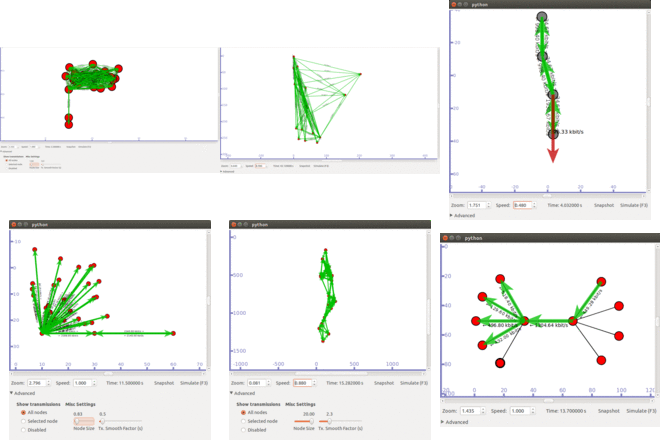 Click Here to watch our latest projects screenshots using NS3 simulator