
How to Begin Implement Network Computational Efficiency in ns3
To implement and analyze Network Computational Efficiency in ns-3, follow these steps. Computational efficiency suggest to the balance between the performance of a network system and the computational resources it consumes for sample CPU usage, memory, and power.
Steps to Begin Implement Network Computational Efficiency in ns3
- Understand Computational Efficiency
Computational efficiency is frequently analyzed in based on:
- Time efficiency: How on rapidly challenges are completed.
- Resource efficiency: How used the optimally computational resources (CPU, memory) are.
- Energy efficiency: The energy consumed per computational challenges or network performance.
In networks, computational effectiveness might measure:
- Processing time per packet.
- Resource usage for protocol operations.
- Efficiency of algorithms used for routing, scheduling, or encoding/decoding.
- Set up Your Environment
Enable the tool ns-3 is installed. Assure the tools for profiling and tracking the performance, like as Valgrind or Perf, for examine the CPU and memory consumption.
- Create the Network Topology
Example: Wireless Network
NodeContainer nodes;
nodes.Create(2); // One transmitter and one receiver
MobilityHelper mobility;
mobility.SetPositionAllocator(“ns3::GridPositionAllocator”,
“MinX”, DoubleValue(0.0),
“MinY”, DoubleValue(0.0),
“DeltaX”, DoubleValue(50.0),
“DeltaY”, DoubleValue(50.0),
“GridWidth”, UintegerValue(2),
“LayoutType”, StringValue(“RowFirst”));
mobility.SetMobilityModel(“ns3::ConstantPositionMobilityModel”);
mobility.Install(nodes);
YansWifiChannelHelper channel = YansWifiChannelHelper::Default();
YansWifiPhyHelper phy = YansWifiPhyHelper::Default();
phy.SetChannel(channel.Create());
WifiHelper wifi;
wifi.SetStandard(WIFI_PHY_STANDARD_80211n);
WifiMacHelper mac;
mac.SetType(“ns3::AdhocWifiMac”);
NetDeviceContainer devices = wifi.Install(phy, mac, nodes);
- Set up the Internet Stack
Install the Internet stack for IP-based transmission:
InternetStackHelper stack;
stack.Install(nodes);
Ipv4AddressHelper address;
address.SetBase(“10.1.1.0”, “255.255.255.0”);
Ipv4InterfaceContainer interfaces = address.Assign(devices);
- Generate Traffic
Install applications for replicate the congestion.
Example: UDP Traffic
UdpEchoServerHelper echoServer(9);
ApplicationContainer serverApps = echoServer.Install(nodes.Get(1)); // Receiver
serverApps.Start(Seconds(1.0));
serverApps.Stop(Seconds(10.0));
UdpEchoClientHelper echoClient(interfaces.GetAddress(1), 9);
echoClient.SetAttribute(“MaxPackets”, UintegerValue(1000));
echoClient.SetAttribute(“Interval”, TimeValue(Seconds(0.01))); // 10ms interval
echoClient.SetAttribute(“PacketSize”, UintegerValue(1024)); // 1KB packets
ApplicationContainer clientApps = echoClient.Install(nodes.Get(0)); // Transmitter
clientApps.Start(Seconds(2.0));
clientApps.Stop(Seconds(10.0));
- Profile Computational Efficiency
CPU Usage
Incorporate the hooks for evaluate the CPU usage:
- Use clock() to calculate the CPU time during replicate the consumed:
#include <ctime>
clock_t start, end;
start = clock();
Simulator::Run();
end = clock();
double cpuTime = static_cast<double>(end – start) / CLOCKS_PER_SEC;
std::cout << “CPU Time Used: ” << cpuTime << ” seconds” << std::endl;
- Use external tools for sample Valgrind, gprof for specific profiling.
Memory Usage
Monitor the memory allocation and consumption:
- Use Valgrind –tool=massif or heaptrack for the track memory consumption during replication.
- Record the memory allocation through alter the code for monitor the malloc() and free() calls are necessary.
- Measure Network Performance
Throughput and Latency
Use FlowMonitor to estimate a network performance of parameter metrics:
FlowMonitorHelper flowmon;
Ptr<FlowMonitor> monitor = flowmon.InstallAll();
Simulator::Stop(Seconds(10.0));
Simulator::Run();
monitor->CheckForLostPackets();
Ptr<Ipv4FlowClassifier> classifier = DynamicCast<Ipv4FlowClassifier>(flowmon.GetClassifier());
std::map<FlowId, FlowMonitor::FlowStats> stats = monitor->GetFlowStats();
for (auto& flow : stats) {
double throughput = flow.second.rxBytes * 8.0 / (flow.second.timeLastRxPacket.GetSeconds() – flow.second.timeFirstTxPacket.GetSeconds()); // bps
std::cout << “Throughput: ” << throughput / 1e6 << ” Mbps” << std::endl;
std::cout << “Average Delay: ” << flow.second.delaySum.GetSeconds() / flow.second.rxPackets << ” seconds” << std::endl;
}
Computational Cost per Packet
Follow the processing time for every packet:
double totalProcessingTime = 0.0;
uint32_t totalPacketsProcessed = 0;
void PacketProcessedCallback(Ptr<const Packet> packet) {
clock_t packetStart = clock();
// Simulate packet processing
clock_t packetEnd = clock();
totalProcessingTime += static_cast<double>(packetEnd – packetStart) / CLOCKS_PER_SEC;
totalPacketsProcessed++;
}
devices.Get(1)->TraceConnectWithoutContext(“MacRx”, MakeCallback(&PacketProcessedCallback));
At the last of the replication, measure the computational cost per packet:
double avgProcessingTime = totalProcessingTime / totalPacketsProcessed;
std::cout << “Average Processing Time per Packet: ” << avgProcessingTime << ” seconds” << std::endl;
- Enable Tracing
ASCII and PCAP Tracing
Create a specific logs for further analysis:
AsciiTraceHelper ascii;
phy.EnableAsciiAll(ascii.CreateFileStream(“computational_efficiency.tr”));
phy.EnablePcapAll(“computational_efficiency”);
- Visualize Results
- Distribute the computational and network performances of parameter metrics for envision the MATLAB or Excel.
- Use to follow the packet flow NetAnim:
AnimationInterface anim(“computational_efficiency.xml”);
- Experiment with Parameters
- Validate the various packet sizes and congestion intervals.
- Different node has density or network topology complexity.
- It replicates the computationally intensive procedures for sample encryption, decoding to analyze their impact.
- Run the Simulation
Process for the replication of outcomes and analyze:
Simulator::Run();
Simulator::Destroy();
Network Computational Efficiency had implemented and executed successfully in ns3 simulation tool are used to achieve network performance. Also, we provide further information related to Network Computational Efficiency functionalities.
 Click Here to watch our latest output video using NS3 simulator
 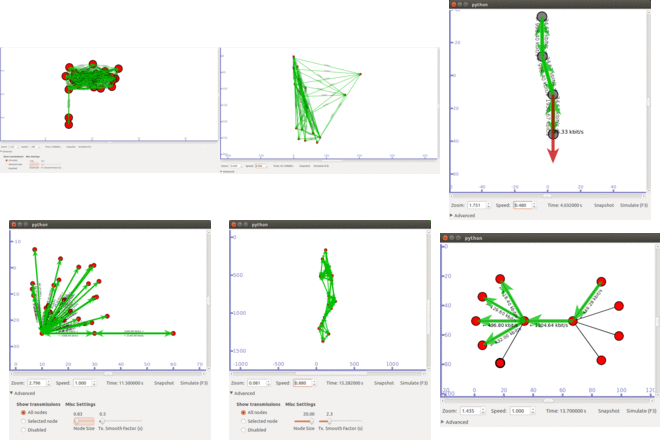 Click Here to watch our latest projects screenshots using NS3 simulator