
How to Begin Implement IP Address Management in NS3
To begin implementing the IP Address Management (IPAM) within NS3 that encompasses to assign, monitor and handle the IP addresses in a simulated network for nodes and devices. It is essential to make sure those nodes contains unique and suitable IP addresses for enabling interaction.
Below is a common instruction to get started with executing IP Address Management in ns3:
Steps to Begin Implement IP Address Management in NS3
- Understand IP Address Management
- Purpose: Allocate one-off IP addresses to nodes or interfaces within a network.
- Key Aspects:
- Subnet creation and management.
- Automatic or manual allocation.
- Preventing IP conflicts.
- Common Mechanisms:
- Dynamic IP Addressing for example using DHCP.
- Static IP Addressing.
- Set Up ns-3
- We should install and set up ns3:
./waf configure –build-profile=debug –enable-examples –enable-tests
./waf build
- Confirm the installation by executing:
./waf –run hello-simulator
- Define IP Addressing Requirements
- Network Topology: Define the topology with required nodes and subnets.
- IP Allocation Strategy:
- Dynamic (automatic assignment to utilize a simulation of DHCP).
- Static (predefined IPs).
- Set Up a Basic Network
Make a basic network topology for experiment the IP address management.
Example: Basic Topology
#include “ns3/core-module.h”
#include “ns3/network-module.h”
#include “ns3/internet-module.h”
#include “ns3/point-to-point-module.h”
#include “ns3/applications-module.h”
using namespace ns3;
int main(int argc, char *argv[])
{
Time::SetResolution(Time::NS);
// Create nodes
NodeContainer nodes;
nodes.Create(3); // Node 0: Client, Node 1: Router, Node 2: Server
// Configure point-to-point links
PointToPointHelper p2p;
p2p.SetDeviceAttribute(“DataRate”, StringValue(“10Mbps”));
p2p.SetChannelAttribute(“Delay”, StringValue(“2ms”));
// Install devices
NetDeviceContainer devices1 = p2p.Install(nodes.Get(0), nodes.Get(1)); // Client to Router
NetDeviceContainer devices2 = p2p.Install(nodes.Get(1), nodes.Get(2)); // Router to Server
// Install Internet stack
InternetStackHelper stack;
stack.Install(nodes);
// Assign IP addresses
Ipv4AddressHelper address;
address.SetBase(“10.1.1.0”, “255.255.255.0”);
Ipv4InterfaceContainer interfaces1 = address.Assign(devices1);
address.SetBase(“10.1.2.0”, “255.255.255.0”);
Ipv4InterfaceContainer interfaces2 = address.Assign(devices2);
// Configure routing
Ipv4GlobalRoutingHelper::PopulateRoutingTables();
// Run simulation
Simulator::Run();
Simulator::Destroy();
return 0;
}
- Implement Static IP Addressing
- For all interfaces, we can predefine IP addresses.
- Allocate certain ranges to subnets with the support of Ipv4AddressHelper.
Example: Static IP Assignment
address.SetBase(“192.168.1.0”, “255.255.255.0”);
Ipv4InterfaceContainer staticInterfaces = address.Assign(devices1);
- Implement Dynamic IP Addressing (Simulating DHCP)
- Mimic a simple DHCP server for active IP addresses allocation.
DHCP Simulation Example
- DHCP Server:
- Make a DHCP server node, which assigns IPs from a pool.
class DhcpServer
{
public:
DhcpServer(Ipv4Address start, Ipv4Address end)
{
m_nextAddress = start;
m_endAddress = end;
}
Ipv4Address Allocate()
{
if (m_nextAddress <= m_endAddress)
{
Ipv4Address assigned = m_nextAddress;
m_nextAddress.Set(m_nextAddress.Get() + 1);
return assigned;
}
else
{
NS_LOG_UNCOND(“DHCP Pool Exhausted”);
return Ipv4Address(“0.0.0.0”);
}
}
private:
Ipv4Address m_nextAddress;
Ipv4Address m_endAddress;
};
- Client Request Simulation:
- Replicate the clients which are demanding IPs from the DHCP server.
void RequestIp(DhcpServer &dhcp)
{
Ipv4Address ip = dhcp.Allocate();
if (ip != Ipv4Address(“0.0.0.0”))
{
NS_LOG_UNCOND(“Allocated IP: ” << ip);
}
}
- Integrate DHCP in Simulation:
- Set the DHCP server in simulation and replicate the IP allocation.
DhcpServer dhcp(Ipv4Address(“192.168.1.100”), Ipv4Address(“192.168.1.200”));
RequestIp(dhcp); // Allocate an IP to the first client
RequestIp(dhcp); // Allocate an IP to the second client
- Simulate Subnetting
- Split the network to numerous subnets with the support of Ipv4AddressHelper.
Example: Multiple Subnets
address.SetBase(“10.1.1.0”, “255.255.255.0”); // Subnet 1
Ipv4InterfaceContainer subnet1Interfaces = address.Assign(devices1);
address.SetBase(“10.1.2.0”, “255.255.255.0”); // Subnet 2
Ipv4InterfaceContainer subnet2Interfaces = address.Assign(devices2);
- Monitor IP Address Usage
- Record allocated IPs for auditing and identifying conflict.
Example: IP Allocation Logging
void LogIpAssignments(const Ipv4InterfaceContainer &interfaces)
{
for (uint32_t i = 0; i < interfaces.GetN(); ++i)
{
NS_LOG_UNCOND(“Node ” << i << ” assigned IP: ” << interfaces.GetAddress(i));
}
}
Request the function:
LogIpAssignments(interfaces1);
LogIpAssignments(interfaces2);
- Run and Test
- Construct the script and run the simulation:
./waf –run scratch/ip-address-management
- Confirm IP assignments within records or outcomes.
- Enhance IP Address Management
- Integrate:
- Conflict Detection: Verify duplicate IPs for identifying conflict.
- Lease Mechanisms: Mimic IP leasing including expiration.
- DHCP Options: Add more set up like gateway, DNS.
- Envision IP assignments and subnet usage to leverage external tools in NS3.
We had shared substantial insights and a basic implementation strategy with examples for executing and enhancing the IP Address Management utilising NS3 environment. Further explanations can be provided upon request.
 Click Here to watch our latest output video using NS3 simulator
 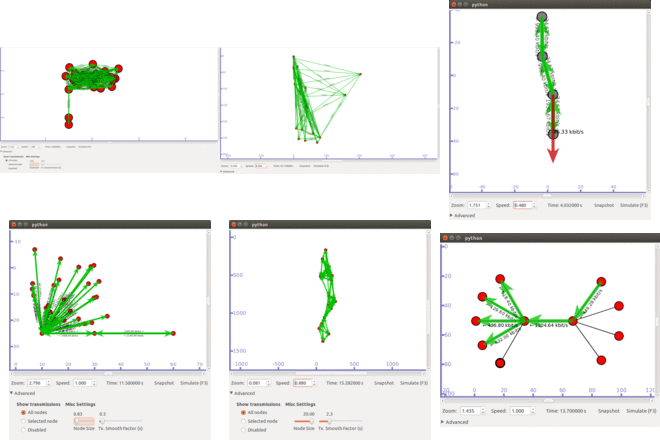 Click Here to watch our latest projects screenshots using NS3 simulator