
How to Begin Implement Distance Routing in NS3
To implement Distance routing in NS3, it normally denote to execute a Distance Vector Routing Protocol such as RIP utilizing NS3. This encompasses to make a protocol in which nodes are interchanging routing data with its neighbors and leverage the distance (cost) parameters for determining the shortest paths to every destination.
Below is a sequential mechanism on how to execute Distance Vector Routing in NS3:
Steps to Begin Implement Distance Routing in NS3
Step 1: Understand Distance Vector Routing
- Key Concepts:
- Every single node sustains a routing table including:
- Destination: Target node.
- Next Hop: Intermediate node for attaining the destination.
- Cost: The metric to the destination for the path.
- Nodes swap routing tables periodically including its neighbors.
- The routing table is modernized according to the Bellman-Ford mechanism: d(u,v)=minw∈neighbors(u){c(u,w)+d(w,v)}d(u, v) = \min_{w \in neighbors(u)} \{c(u, w) + d(w, v)\}d(u,v)=w∈neighbors(u)min{c(u,w)+d(w,v)} where:
- d(u,v)d(u, v)d(u,v): Cost from uuu to vvv.
- d(w,v)d(w, v)d(w,v): Cost from www to vvv.
- c(u,w)c(u, w)c(u,w): Cost from uuu to neighbor www.
- Every single node sustains a routing table including:
- Characteristics:
- It makes simpler to execute.
- Susceptible to the count-to-infinity challenges like loops.
Step 2: Set Up NS3
- Install NS3:
git clone https://gitlab.com/nsnam/ns-3-dev.git
cd ns-3-dev
./ns3 configure –enable-examples –enable-tests
./ns3 build
- Verify Installation: Execute a sample simulation scripts to confirm the set up:
./ns3 run examples/tutorial/first
Step 3: Plan the Protocol Design
- Core Components:
- Routing Table: Links destinations to next hops and costs.
- Periodic Updates: Periodically interchanges routing tables including neighbors.
- Route Computation: Modernizes the routing table with received updates.
- Implementation Workflow:
- Set the routing table including direct neighbors.
- Swap routing data periodically with neighbors.
- According to the Bellman-Ford mechanism, bring up to date routing table.
Step 4: Implement Distance Routing
Step 4.1: Define the Protocol Class
Describe the protocol class to prolong the Ipv4RoutingProtocol class:
#include “ns3/ipv4-routing-protocol.h”
#include “ns3/socket.h”
#include <map>
using namespace ns3;
class DistanceRouting : public Ipv4RoutingProtocol {
public:
static TypeId GetTypeId(void);
DistanceRouting();
virtual ~DistanceRouting();
virtual Ptr<Ipv4Route> RouteOutput(Ptr<Packet> packet, const Ipv4Header &header,
Ptr<NetDevice> oif, Socket::SocketErrno &sockerr) override;
virtual bool RouteInput(Ptr<const Packet> packet, const Ipv4Header &header,
Ptr<const NetDevice> idev, UnicastForwardCallback ucb,
MulticastForwardCallback mcb, LocalDeliverCallback lcb,
ErrorCallback ecb) override;
void NotifyInterfaceUp(uint32_t interface) override;
void NotifyInterfaceDown(uint32_t interface) override;
private:
void InitializeRoutingTable();
void SendRoutingUpdates();
void ReceiveRoutingUpdates(Ptr<Socket> socket);
void UpdateRoutingTable(Ipv4Address neighbor, const std::map<Ipv4Address, uint32_t> &neighborTable);
std::map<Ipv4Address, std::pair<Ipv4Address, uint32_t>> m_routingTable; // Destination -> (NextHop, Cost)
Ptr<Socket> m_socket;
};
Step 4.2: Implement Core Functions
- Initialize the Routing Table: Inhabit the routing table including direct neighbors.
void DistanceRouting::InitializeRoutingTable() {
for (uint32_t i = 0; i < GetNode()->GetNDevices(); ++i) {
Ptr<NetDevice> device = GetNode()->GetDevice(i);
Ipv4Address address = GetNode()->GetObject<Ipv4>()->GetAddress(i, 0).GetLocal();
m_routingTable[address] = {address, 0}; // Cost to itself is 0
}
}
- Send Routing Updates: Transmit routing updates periodically to the neighbors.
void DistanceRouting::SendRoutingUpdates() {
Ptr<Packet> packet = Create<Packet>();
for (const auto &entry : m_routingTable) {
// Serialize routing table entries into packet
}
for (uint32_t i = 0; i < GetNode()->GetNDevices(); ++i) {
Ptr<NetDevice> device = GetNode()->GetDevice(i);
m_socket->SendTo(packet, 0, InetSocketAddress(Ipv4Address(“255.255.255.255”), 520));
}
Simulator::Schedule(Seconds(10.0), &DistanceRouting::SendRoutingUpdates, this);
}
- Update the Routing Table: Modernize the routing table to leverage Bellman-Ford depends on the received updates.
void DistanceRouting::UpdateRoutingTable(Ipv4Address neighbor,
const std::map<Ipv4Address, uint32_t> &neighborTable) {
for (const auto &entry : neighborTable) {
Ipv4Address dest = entry.first;
uint32_t costToDest = entry.second;
uint32_t newCost = m_routingTable[neighbor].second + costToDest;
if (m_routingTable.find(dest) == m_routingTable.end() || newCost < m_routingTable[dest].second) {
m_routingTable[dest] = {neighbor, newCost};
}
}
}
- Packet Forwarding: According to the routing table, transmit the packets.
Ptr<Ipv4Route> DistanceRouting::RouteOutput(Ptr<Packet> packet, const Ipv4Header &header,
Ptr<NetDevice> oif, Socket::SocketErrno &sockerr) {
Ptr<Ipv4Route> route = Create<Ipv4Route>();
auto it = m_routingTable.find(header.GetDestination());
if (it != m_routingTable.end()) {
route->SetDestination(header.GetDestination());
route->SetGateway(it->second.first); // Use next hop from routing table
route->SetOutputDevice(oif);
}
return route;
}
bool DistanceRouting::RouteInput(Ptr<const Packet> packet, const Ipv4Header &header,
Ptr<const NetDevice> idev, UnicastForwardCallback ucb,
MulticastForwardCallback mcb, LocalDeliverCallback lcb,
ErrorCallback ecb) {
if (header.GetDestination() == GetNode()->GetObject<Ipv4>()->GetAddress(1, 0).GetLocal()) {
lcb(packet, header, idev); // Deliver locally
return true;
}
auto it = m_routingTable.find(header.GetDestination());
if (it != m_routingTable.end()) {
Ptr<Ipv4Route> route = Create<Ipv4Route>();
route->SetDestination(header.GetDestination());
route->SetGateway(it->second.first); // Use next hop from routing table
ucb(route, packet, header);
return true;
}
return false;
}
Step 5: Register the Protocol
- Register with NS3: Add the protocol with the TypeId system of NS3.
TypeId DistanceRouting::GetTypeId(void) {
static TypeId tid = TypeId(“ns3::DistanceRouting”)
.SetParent<Ipv4RoutingProtocol>()
.SetGroupName(“Internet”)
.AddConstructor<DistanceRouting>();
return tid;
}
Step 6: Integrate into a Simulation
- Simulation Script Example:
#include “ns3/internet-stack-helper.h”
#include “ns3/distance-routing.h”
int main(int argc, char *argv[]) {
NodeContainer nodes;
nodes.Create(4);
PointToPointHelper p2p;
p2p.SetDeviceAttribute(“DataRate”, StringValue(“10Mbps”));
p2p.SetChannelAttribute(“Delay”, StringValue(“2ms”));
NetDeviceContainer devices = p2p.Install(nodes.Get(0), nodes.Get(1));
devices.Add(p2p.Install(nodes.Get(1), nodes.Get(2)));
devices.Add(p2p.Install(nodes.Get(2), nodes.Get(3)));
InternetStackHelper stack;
Ptr<DistanceRouting> distanceRouting = CreateObject<DistanceRouting>();
stack.SetRoutingHelper(distanceRouting);
stack.Install(nodes);
Simulator::Run();
Simulator::Destroy();
return 0;
}
Step 7: Test and Debug
- Enable Logging:
export NS_LOG=”DistanceRouting=level_all|prefix_time”
./ns3 run my-simulation
- Validate:
- Confirm the updates of routing table.
- Observe packet forwarding and route selection.
Step 8: Extend and Optimize
- Enhancements:
- Execute the divided horizon for avoiding loops.
- Integrate dynamic performance indicators such as delay or bandwidth.
- Performance Testing:
- Experiment the performance within large-scale networks.
- Probe scalability and convergence time.
We had demonstrated a collection of implementation steps to execute and extend the Distance Routing via NS3 platform. We can explore this subject further and offer complete information upon request.
 Click Here to watch our latest output video using NS3 simulator
 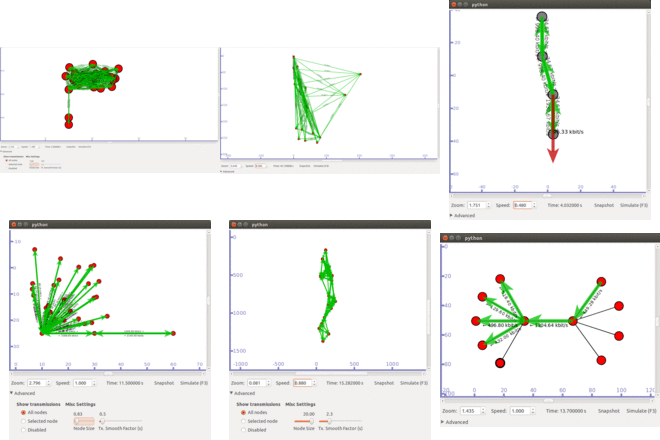 Click Here to watch our latest projects screenshots using NS3 simulator