
Archive
User-contributed or crowd-sourced information is becoming increasingly common. In this paper, we consider the specific case of participatory sensing whereby people contribute information captured bysensors, typically those on a smartphone, and share the information with others. We propose a new metric called quality of contributed service (QCS) which characterizes the information quality and timeliness of […]
We introduce a new tendency measure for a probability mass function (pmf) referred to as “tenor,” and defined in terms of the phase of the first non-zero frequency of the discrete Fourier transform of the pmf. This statistic is in the vicinity of the region of highest probability of the pmf. Unlike mean, tenor is […]
Developing science-based strategies to best balance estuarine use and resilience is critical to a sustainable earth, but is also challenging. To meet the challenge, we created for the Columbia River estuary, in the United States, a distinctive scientific infrastructure that we term “collaboratory.” We define collaboratory as a networked integration of sensors, platforms, models, data, analyses, and collaboration […]
Location-aware applications have been used widely with the assistance of the latest positioning features in Smart Phone such as GPS, AGPS, etc. However, all the existing applications gather users’ geographical data and transfer them into the pertinent information to give meaning and value. For this kind of solutions, the user’s privacy and security issues might […]
Big data as name implies that data that’s in large as nature, is known as big data. Big data is used to describe a large volume of structure way. Big Data concern large-amount, complex, growing data sets with multiple, autonomous sources, networking, data storage, and data collection capacity, These data are rapidly expanding in all science […]
In a mobile ad hoc network (MANET), communication between mobile nodes occurs without centralized control. In this environment the mobility of a node is unpredictable; this is considered as a characteristic of wireless networks. Because of faulty or malicious nodes, the network is vulnerable to routing misbehavior. The resource constrained characteristics of MANETs leads to increased query […]
The paper presents the results of simulation verification of trust-based protection mechanism (TUBE) to attacks on a reputation systems. The authors give a short description of TUBE scheme and present a review of typical reputation attacks. The TUBE scheme supports the MANET nodes operations allowing assessment of the nodes surrounding and use of this information to increase […]
A Mobile Ad-hoc Network (MANET) is a constantly self-configuring, infrastructure-less network of mobile devices where each device is wireless, moves without restraint and be a router to put across traffic unassociated to its own use. Every device must be prepared to constantly sustain the information obligatory for routing the traffic. And this is the main […]
Based on end user application a network of hundreds or even thousands of sensor nodes, also known as wireless sensor network, can collect valuable data from an unassisted environment and transmit the information to the user. This transmission can be routed from one node to another using numerous routing protocols for wireless sensor network. Though […]
A desired capability in military operations is the reliable and efficient sharing of Situational Awareness (SA) data at the tactical edge network. Many implementations of SA sharing in the literature use frequent broadcasts of SA messages in order to provide an up-to-date and comprehensive operating picture to all nodes. However, SA sharing may result in […]
 Click Here to watch our latest output video using NS3 simulator
 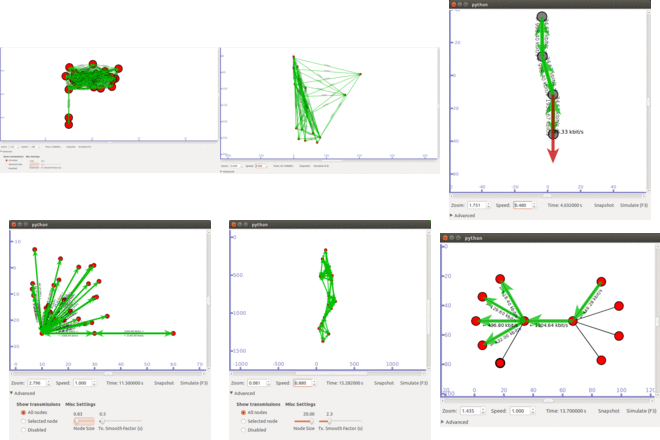 Click Here to watch our latest projects screenshots using NS3 simulator