
How to Run Network Scalability in NS3
To begin implementing the network scalability in NS3, which is a discrete-event network simulator that needs to model and replicate the network scenarios to learn how network performance acts like the amount of nodes, devices, or traffic scales up. Below is a stepwise method to get started:
Steps to Begin Implement Network Scalability in NS3
- Understand Network Scalability Requirements
- Detect parameters for estimating the scalability like throughput, latency, packet loss, energy utilization.
- Discover the type of network like wireless, wired, IoT, VANET and protocols are included.
- Describe the scalability objective with node count, traffic load, or protocol robustness in scaling.
- Set Up ns3 Environment
- Install ns3: We can adhere to the ns3 installation instruction to set up NS3.
sudo apt-get install g++ python3 python3-pip git
git clone https://gitlab.com/nsnam/ns-3-dev.git
cd ns-3-dev
./ns3 configure –enable-examples –enable-tests
./ns3 build
- Confirm the installation including:
./ns3 run hello-simulator
- Choose the Network Model
- Basic Examples: Learn basic scenarios to utilize instances from the examples/ directory.
- Samples contain basic wired topologies or wireless networks.
- Detect or fine-tune an example, which makes parallel with the scalability objectives.
- Design a Scalable Scenario
- Node Creation:
- Make a large amount of nodes using NodeContainer.
NodeContainer nodes;
nodes.Create(100); // Create 100 nodes
- Topology:
- For wired networks, we need to leverage PointToPointHelper or CsmaHelper.
- Make use of WifiHelper or LrWpanHelper for wireless configurations.
- Applications:
- We can install applications such as UDP, TCP, or custom traffic generators with the support of ApplicationContainer.
- Mobility (if needed):
- Integrate random, grid, or constant location mobility using MobilityHelper as required.
- Scale-Up Configurations
- Maximize the volume of nodes within NodeContainer.
- Set up connections to leverage PointToPointHelper or same to accomplish high traffic.
- Execute the load balancing approaches as necessary.
- Measure Performance Metrics
- Accumulate the performance information to apply FlowMonitor:
Ptr<FlowMonitor> monitor;
FlowMonitorHelper flowmon;
monitor = flowmon.InstallAll();
- Analyze performance parameters such as throughput, delay, or packet delivery ratio.
- Iterate and Optimize
- Execute the simulations along with maximizing node counts or traffic loads.
- Detect blockages and enhance:
- Fine-tune queue sizes.
- Test with various routing protocols such as AODV, OLSR, DSDV, and so on.
- Modify MAC or physical layer settings.
- Log and Visualize Results
- Leverage AsciiTraceHelper or custom logging approaches to record outcomes.
- Make use of visualization tools like:
- NetAnim: Used for real-time or post-simulation animation.
- Python/matplotlib: It supports to examine and envision the outcomes.
- Example Code for Scalable Wireless Network
Below is a basic example structure of scalable wireless network:
#include “ns3/core-module.h”
#include “ns3/network-module.h”
#include “ns3/mobility-module.h”
#include “ns3/wifi-module.h”
#include “ns3/internet-module.h”
#include “ns3/flow-monitor-module.h”
using namespace ns3;
int main(int argc, char *argv[]) {
NodeContainer wifiNodes;
wifiNodes.Create(100); // 100 nodes
YansWifiChannelHelper channel = YansWifiChannelHelper::Default();
YansWifiPhyHelper phy = YansWifiPhyHelper::Default();
phy.SetChannel(channel.Create());
WifiHelper wifi;
wifi.SetRemoteStationManager(“ns3::AarfWifiManager”);
NqosWifiMacHelper mac = NqosWifiMacHelper::Default();
mac.SetType(“ns3::AdhocWifiMac”);
NetDeviceContainer devices = wifi.Install(phy, mac, wifiNodes);
MobilityHelper mobility;
mobility.SetMobilityModel(“ns3::RandomWalk2dMobilityModel”,
“Bounds”, RectangleValue(Rectangle(-50, 50, -50, 50)));
mobility.Install(wifiNodes);
InternetStackHelper stack;
stack.Install(wifiNodes);
Ipv4AddressHelper address;
address.SetBase(“10.1.1.0”, “255.255.255.0”);
Ipv4InterfaceContainer interfaces = address.Assign(devices);
FlowMonitorHelper flowmon;
Ptr<FlowMonitor> monitor = flowmon.InstallAll();
Simulator::Stop(Seconds(10.0));
Simulator::Run();
monitor->SerializeToXmlFile(“scalability-results.xml”, true, true);
Simulator::Destroy();
return 0;
}
This step-by-step approach ensures a solid foundation for implementing the Network Scalability, analyzing and visualizing the results in NS3 simulator. Furthermore, we can extend the process for better understanding, if required.
 Click Here to watch our latest output video using NS3 simulator
 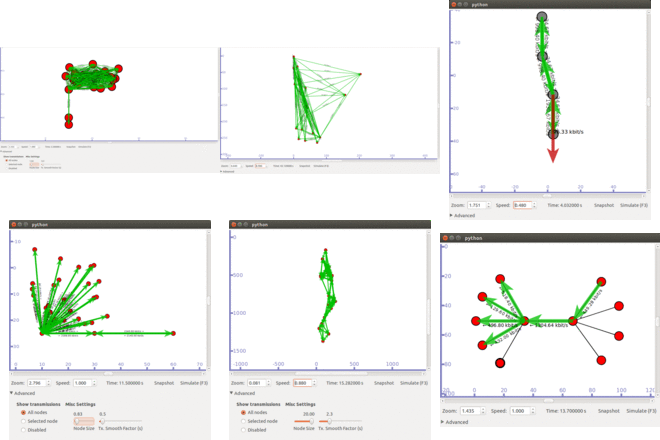 Click Here to watch our latest projects screenshots using NS3 simulator