
How to Begin Implement Network Recovery in NS3
To begin implementing and analysing the network recovery using ns3, we can replicate a network scenario in which network failure happens and execute the methods for retrieving from it like re-routing, restoring links, or redistributing traffic. Here’s a simple guide to get started:
Steps to Begin Implement Network Recovery in NS3
- Understand the Concept
- Network Recovery consists of controlling the network failures like link/node failure and repairing typical network operations.
- General network recovery approaches like:
- Route Reconfiguration: It used to update the routing tables for preventing failed routes.
- Traffic Redistribution: Readdressing the traffic which helps to backup links or nodes.
- Network Restoration: Physically or logically renovating the failed modules.
- Set Up ns3
- We can download and install ns3 on the system properly:
./waf configure –build-profile=debug –enable-examples –enable-tests
./waf build
- Confirm the set up by executing:
./waf –run hello-simulator
- Choose a Recovery Scenario
- Node Failure: A node flops, and traffic requires to be redirected.
- Link Failure: A link breakdowns, and another routes have to leverage.
- Congestion Recovery: High traffic is redeployed to minimize the congested routes.
- Set Up Topology
Make a network topology that contains numerous routes among the source and destination nodes for permitting retrieval.
Example: Topology with Redundant Paths
NodeContainer nodes;
nodes.Create(6); // Node 0: Source, Node 5: Destination
// Define Point-to-Point links
PointToPointHelper p2p;
p2p.SetDeviceAttribute(“DataRate”, StringValue(“10Mbps”));
p2p.SetChannelAttribute(“Delay”, StringValue(“2ms”));
// Connect nodes
NetDeviceContainer d0 = p2p.Install(nodes.Get(0), nodes.Get(1));
NetDeviceContainer d1 = p2p.Install(nodes.Get(1), nodes.Get(2));
NetDeviceContainer d2 = p2p.Install(nodes.Get(2), nodes.Get(5));
NetDeviceContainer backup1 = p2p.Install(nodes.Get(0), nodes.Get(3));
NetDeviceContainer backup2 = p2p.Install(nodes.Get(3), nodes.Get(4));
NetDeviceContainer backup3 = p2p.Install(nodes.Get(4), nodes.Get(5));
- Introduce Failures
During the simulation runtime, we need to replicate a failure.
Example: Link Failure
void SimulateLinkFailure(Ptr<Node> node1, Ptr<Node> node2)
{
Ptr<Ipv4> ipv4Node1 = node1->GetObject<Ipv4>();
Ptr<Ipv4> ipv4Node2 = node2->GetObject<Ipv4>();
int32_t interface1 = ipv4Node1->GetInterfaceForDevice(node1->GetDevice(0));
int32_t interface2 = ipv4Node2->GetInterfaceForDevice(node2->GetDevice(0));
ipv4Node1->SetDown(interface1);
ipv4Node2->SetDown(interface2);
NS_LOG_UNCOND(“Link between ” << node1->GetId() << ” and ” << node2->GetId() << ” failed at ” << Simulator::Now().GetSeconds() << ” seconds”);
}
Schedule the Failure
Simulator::Schedule(Seconds(5.0), &SimulateLinkFailure, nodes.Get(1), nodes.Get(2));
- Implement Recovery Mechanism
- Re-routing: Update routing tables with the support of Ipv4GlobalRoutingHelper.
Ipv4GlobalRoutingHelper::RecomputeRoutingTables();
- Traffic Redistribution: Manually or dynamically, we can integrate the backup route.
Example: Add a Backup Route
Ptr<Ipv4> ipv4 = nodes.Get(0)->GetObject<Ipv4>();
Ipv4StaticRoutingHelper staticRoutingHelper;
Ptr<Ipv4StaticRouting> staticRouting = staticRoutingHelper.GetStaticRouting(ipv4);
// Add backup route
staticRouting->AddHostRouteTo(Ipv4Address(“10.1.3.2”), Ipv4Address(“10.1.1.1”), 1);
- Monitor Recovery
Confirm the recovery using FlowMonitor.
Example: Set Up FlowMonitor
FlowMonitorHelper flowmonHelper;
Ptr<FlowMonitor> monitor = flowmonHelper.InstallAll();
Simulator::Stop(Seconds(20.0));
Simulator::Run();
monitor->SerializeToXmlFile(“recovery-flow-monitor.xml”, true, true);
- Run the Simulation
Construct the script then execute the simulation of network recovery:
./waf –run scratch/network-recovery
- Analyze Results
- Verify records for route updates.
- Examine FlowMonitor outcomes for metrics like throughput, delay, and packet loss before and after failure.
We have carried out effective implementation and analysis process for executing Network Recovery using a step-by-step approach in NS3 environment. More innovative insights and concepts related to this topic will be offered in the future.
 Click Here to watch our latest output video using NS3 simulator
 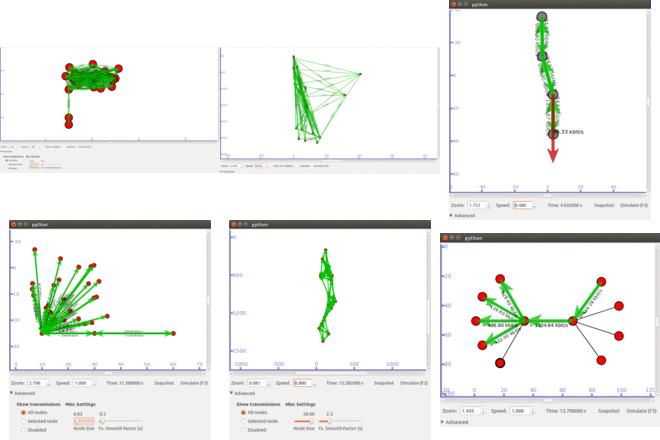 Click Here to watch our latest projects screenshots using NS3 simulator