
How to Begin Implement Network SNR and SINR in NS3
To begin Signal-to-Noise Ratio (SNR) and Signal-to-Interference-plus-Noise Ratio (SINR) using ns3, we can adhere to these steps. These parameters are essential to know the wireless communication channels quality. Here’s a simplified approach on how to get started with network SNR and SINR using NS3:
Steps to Begin Network SNR and SINR in NS3
- Understand SNR and SINR
- SNR:
SNR=Signal PowerNoise Power\text{SNR} = \frac{\text{Signal Power}}{\text{Noise Power}}SNR=Noise PowerSignal Power
- SINR:
SINR=Signal PowerInterference Power+Noise Power\text{SINR} = \frac{\text{Signal Power}}{\text{Interference Power} + \text{Noise Power}}SINR=Interference Power+Noise PowerSignal Power
Where:
- Signal Power is the preferred signal power.
- Noise Power according to the channel and environment such as thermal noise.
- Interference Power arrives from other transmitters within the network.
- Set Up Your Environment
We can install and download ns3 on the system. Make use of proper components such as Wi-Fi, LTE, or 5G based on the scenario.
- Create a Network Topology
Example: Wireless Network
NodeContainer nodes;
nodes.Create(3); // One transmitter, one receiver, and one interferer
MobilityHelper mobility;
mobility.SetPositionAllocator(“ns3::GridPositionAllocator”,
“MinX”, DoubleValue(0.0),
“MinY”, DoubleValue(0.0),
“DeltaX”, DoubleValue(50.0),
“DeltaY”, DoubleValue(50.0),
“GridWidth”, UintegerValue(3),
“LayoutType”, StringValue(“RowFirst”));
mobility.SetMobilityModel(“ns3::ConstantPositionMobilityModel”);
mobility.Install(nodes);
YansWifiChannelHelper channel = YansWifiChannelHelper::Default();
YansWifiPhyHelper phy = YansWifiPhyHelper::Default();
phy.SetChannel(channel.Create());
WifiHelper wifi;
wifi.SetStandard(WIFI_PHY_STANDARD_80211n);
WifiMacHelper mac;
mac.SetType(“ns3::AdhocWifiMac”);
NetDeviceContainer devices = wifi.Install(phy, mac, nodes);
- Set Up the Internet Stack
We should install the Internet stack allowed for IP-based interaction:
InternetStackHelper stack;
stack.Install(nodes);
Ipv4AddressHelper address;
address.SetBase(“10.1.1.0”, “255.255.255.0”);
Ipv4InterfaceContainer interfaces = address.Assign(devices);
- Generate Traffic
To simulate traffic, we need to install applications.
Example: UDP Traffic
UdpEchoServerHelper echoServer(9);
ApplicationContainer serverApps = echoServer.Install(nodes.Get(1)); // Receiver
serverApps.Start(Seconds(1.0));
serverApps.Stop(Seconds(10.0));
UdpEchoClientHelper echoClient(interfaces.GetAddress(1), 9);
echoClient.SetAttribute(“MaxPackets”, UintegerValue(1000));
echoClient.SetAttribute(“Interval”, TimeValue(Seconds(0.01))); // 10ms interval
echoClient.SetAttribute(“PacketSize”, UintegerValue(1024)); // 1KB packets
ApplicationContainer clientApps = echoClient.Install(nodes.Get(0)); // Transmitter
clientApps.Start(Seconds(2.0));
clientApps.Stop(Seconds(10.0));
- Measure SNR
Using PHY Layer Callbacks
Monitor the SNR with the support of WifiPhy:
Ptr<WifiPhy> phy = DynamicCast<WifiNetDevice>(devices.Get(1))->GetPhy();
std::vector<double> snrValues;
phy->TraceConnectWithoutContext(“Snr”, MakeCallback([&](double snr) {
snrValues.push_back(snr);
std::cout << “SNR (dB): ” << snr << std::endl;
}));
Change the SNR from dB to linear scale as required:
double snrLinear = std::pow(10, snr / 10); // Convert SNR from dB to linear
- Measure SINR
Using Interference Model
Estimate the SINR on the receiver within a multi-node network by deliberating signal power, interference power, and noise power.
- Signal Power:
double signalPower = phy->GetTxPowerStart(); // Example signal power in dBm
signalPower = std::pow(10, signalPower / 10) / 1000; // Convert dBm to watts
- Noise Power: It is designed for a thermal noise floor:
Noise Power=k⋅T⋅B\text{Noise Power} = k \cdot T \cdot BNoise Power=k⋅T⋅B
Where:
- k=1.38×10⁻²³k = 1.38 \times 10^{-23}k=1.38×10⁻²³ (Boltzmann constant in J/K).
- TTT: Temperature in Kelvin (e.g., 290K).
- BBB: Bandwidth in Hz.
double bandwidth = 20e6; // 20 MHz
double noisePower = 1.38e-23 * 290 * bandwidth; // Noise power in watts
- Interference Power: Monitor interference power from other nodes such as interferer node:
double interferencePower = …; // Calculate based on interfering nodes
- SINR Calculation:
double sinr = signalPower / (interferencePower + noisePower);
std::cout << “SINR: ” << sinr << ” (linear)” << std::endl;
std::cout << “SINR: ” << 10 * std::log10(sinr) << ” dB” << std::endl;
- Analyze Results
Examine the values of SNR and SINR which are accumulated after the simulation:
- Transfer the values into external tools such as MATLAB or Excel for graphical analysis.
- Examine trends including diverse distances, interference, or traffic load.
- Enable Tracing
ASCII and PCAP Tracing
Make comprehensive records of SNR and SINR events:
AsciiTraceHelper ascii;
phy.EnableAsciiAll(ascii.CreateFileStream(“snr_sinr_analysis.tr”));
phy.EnablePcapAll(“snr_sinr_analysis”);
- Experiment with Parameters
- Distance: Experiment with diverse distances among the transmitter and receiver.
- Interference: Establish an interferer node to make traffic:
UdpEchoClientHelper interfererClient(interfaces.GetAddress(1), 9);
interfererClient.SetAttribute(“MaxPackets”, UintegerValue(1000));
interfererClient.SetAttribute(“Interval”, TimeValue(Seconds(0.01)));
interfererClient.SetAttribute(“PacketSize”, UintegerValue(1024));
ApplicationContainer interfererApps = interfererClient.Install(nodes.Get(2)); // Interferer
interfererApps.Start(Seconds(2.0));
interfererApps.Stop(Seconds(10.0));
- Modulation Scheme: Test with various PHY settings such as BPSK, QPSK.
- Run the Simulation
Finally, execute the simulation and then monitor the outcomes:
Simulator::Run();
Simulator::Destroy();
We have illustrated the detailed implementation process for executing and examining the Network SNR and SINR using NS3 sample snippets. More advanced details regarding this topic can be added as required.
 Click Here to watch our latest output video using NS3 simulator
 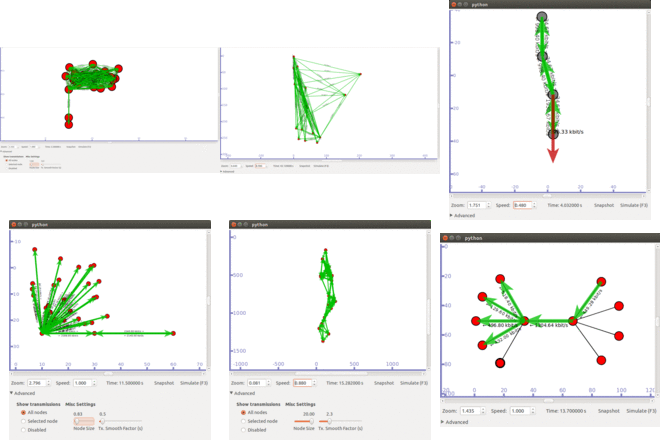 Click Here to watch our latest projects screenshots using NS3 simulator