
How to Begin Implement VLAN Trunking Protocol in NS3
To implement VLAN Trunking Protocol (VTP) using NS3 which is a Cisco-proprietary protocol that frequently utilized for handling the VLAN sets up through a network of switches. To execute VTP within NS3 that has contains to replicate the VLANs, sustain a consistent VLAN database through simulated switches, and actively modernizing VLAN sets up.
Below is a step-by-step approach on how to implement the VLAN Trunking Protocol (VTP) in NS3:
Steps to Begin Implement VLAN Trunking Protocol in NS3
Step 1: Understand VLAN Trunking Protocol (VTP)
- Key Concepts:
- VTP Modes:
- Server Mode: Switches in this mode can make, change, and remove the VLANs. These updates are broadcasted to every switch.
- Client Mode: Within this mode, switches inherit the updates of VLAN from servers however it cannot create modifications.
- Transparent Mode: Switches do not take part in VTP nevertheless it transmits the VTP advertisements.
- VTP Advertisement:
- VLAN updates are forwarded as commercials, making sure reliability through the network.
- VLAN Database:
- A table saving the VLAN database IDs and its names.
- VTP Modes:
- Use Cases:
- It sustains consistent VLAN sets up including numerous switches within networks.
- Make simpler VLAN management.
Step 2: Set Up NS3
- Install NS3:
git clone https://gitlab.com/nsnam/ns-3-dev.git
cd ns-3-dev
./ns3 configure –enable-examples –enable-tests
./ns3 build
- Verify Installation: Confirm installation by executing an example script:
./ns3 run examples/tutorial/first
Step 3: Plan VTP Implementation
- Core Components:
- VLAN Database: Saves VLAN sets up like ID, name.
- VTP Advertisements: Transmit VLAN configurations periodically.
- VTP Modes: Describe the behavior of VTP modes like server, client, and transparent modes.
- Workflow:
- Set VLAN database on the switches.
- Set up every single switch including a VTP mode.
- Transmit VTP advertisements periodically.
- Modernize VLAN database according to the received advertisements.
Step 4: Implement VTP in NS3
Step 4.1: Define the VTP Protocol Class
To replicate the behaviour of VTP, we need to prolong the NS3 Application class:
#include “ns3/application.h”
#include <map>
#include <string>
using namespace ns3;
class VtpApplication : public Application {
public:
static TypeId GetTypeId(void);
VtpApplication();
virtual ~VtpApplication();
void SetMode(std::string mode);
void AddVlan(uint16_t vlanId, std::string vlanName);
void StartVtp();
private:
void SendVtpAdvertisement();
void ReceiveVtpAdvertisement(Ptr<Packet> packet);
std::string m_mode; // VTP mode: server, client, transparent
std::map<uint16_t, std::string> m_vlanDatabase; // VLAN ID -> VLAN Name
Ptr<Socket> m_socket;
};
Step 4.2: Implement Core Functions
- Set VTP Mode: Set up the behavior of switch.
void VtpApplication::SetMode(std::string mode) {
m_mode = mode;
}
- Add VLAN: Enable VLAN creation or alteration for server mode only.
void VtpApplication::AddVlan(uint16_t vlanId, std::string vlanName) {
if (m_mode == “server”) {
m_vlanDatabase[vlanId] = vlanName;
}
}
- Start VTP: Start the periodic VTP commercials.
void VtpApplication::StartVtp() {
if (m_mode == “server” || m_mode == “client”) {
Simulator::Schedule(Seconds(10.0), &VtpApplication::SendVtpAdvertisement, this);
}
}
- Send VTP Advertisement: Transmit the VLAN database for advertisement.
void VtpApplication::SendVtpAdvertisement() {
Ptr<Packet> packet = Create<Packet>();
// Serialize VLAN database into packet
for (const auto &entry : m_vlanDatabase) {
// Add VLAN ID and name to the packet
}
m_socket->Send(packet);
Simulator::Schedule(Seconds(10.0), &VtpApplication::SendVtpAdvertisement, this);
}
- Receive VTP Advertisement: Depends on the received advertisements, we need to modernize the VLAN database.
void VtpApplication::ReceiveVtpAdvertisement(Ptr<Packet> packet) {
if (m_mode == “client” || m_mode == “server”) {
std::map<uint16_t, std::string> receivedDatabase;
// Deserialize the packet into receivedDatabase
for (const auto &entry : receivedDatabase) {
if (m_vlanDatabase.find(entry.first) == m_vlanDatabase.end()) {
m_vlanDatabase[entry.first] = entry.second; // Update database
}
}
}
}
Step 5: Register the Application
Enrol the application including TypeId system in NS3:
TypeId VtpApplication::GetTypeId(void) {
static TypeId tid = TypeId(“ns3::VtpApplication”)
.SetParent<Application>()
.SetGroupName(“Applications”)
.AddConstructor<VtpApplication>();
return tid;
}
Step 6: Integrate into a Simulation
- Simulation Script Example:
#include “ns3/internet-stack-helper.h”
#include “ns3/vtp-application.h”
int main(int argc, char *argv[]) {
NodeContainer switches;
switches.Create(3); // Three switches
PointToPointHelper p2p;
p2p.SetDeviceAttribute(“DataRate”, StringValue(“1Gbps”));
p2p.SetChannelAttribute(“Delay”, StringValue(“2ms”));
// Connect switches
p2p.Install(switches.Get(0), switches.Get(1));
p2p.Install(switches.Get(1), switches.Get(2));
InternetStackHelper stack;
stack.Install(switches);
// Configure VTP on switches
Ptr<VtpApplication> switch1App = CreateObject<VtpApplication>();
switch1App->SetMode(“server”);
switch1App->AddVlan(10, “Sales”);
switch1App->AddVlan(20, “Engineering”);
switch1App->SetNode(switches.Get(0));
Ptr<VtpApplication> switch2App = CreateObject<VtpApplication>();
switch2App->SetMode(“client”);
switch2App->SetNode(switches.Get(1));
Ptr<VtpApplication> switch3App = CreateObject<VtpApplication>();
switch3App->SetMode(“transparent”);
switch3App->SetNode(switches.Get(2));
Simulator::Run();
Simulator::Destroy();
return 0;
}
Step 7: Test and Debug
- Enable Logging: Make use of NS3 logging for debugging the protocol:
export NS_LOG=”VtpApplication=level_all|prefix_time”
./ns3 run my-simulation
- Verify VLAN Consistency:
- Make sure that every client inherits the updates from the server.
- Confirm dynamic VLAN integration or elimination within server mode.
Step 8: Extend and Optimize
- Enhancements:
- Execute the VTP pruning for minimizing the unnecessary traffic.
- Integrate support for VTP versioning, making sure compatibility.
- Performance Testing:
- Replicate the performance of protocol testing in larger switch networks.
- Estimate protocol overhead and synchronization time.
Here, step-by-step implementation process of VLAN Trunking Protocol has been successfully completed by leveraging NS3 simulation tool. We are ready to expand on this if required.
 Click Here to watch our latest output video using NS3 simulator
 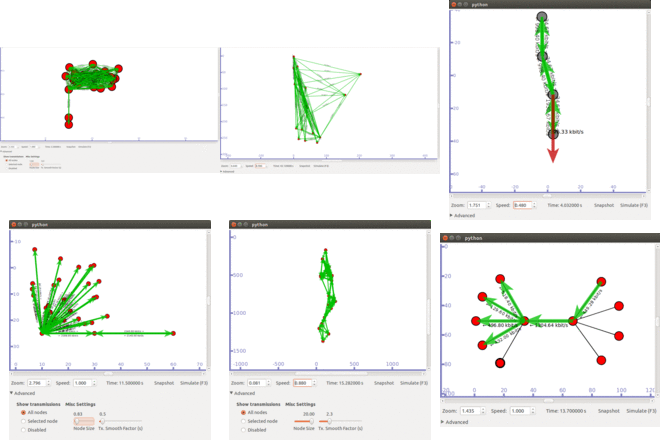 Click Here to watch our latest projects screenshots using NS3 simulator