
How to Begin Implement Fastest Protocol in NS3
To start executing a Fastest Protocol in NS3 that has requires making a custom protocol which is intended for reducing end-to-end delay or enhancing for fast data delivery. It should be a transport-layer protocol, routing protocol, or even a MAC-layer protocol according to the objectives.
We follow these steps to start implementing custom “Fastest Protocol” in NS3.
Steps to Begin Implement Fastest Protocol in NS3
Step 1: Define Protocol Goals
We must describe the crucial aspects and objectives of the project, before jumping into implementation:
- Layer of Operation: Define it function on the routing such as network layer, transport layer, or MAC layer.
- Optimization Target:
- Reduce latency (end-to-end delay).
- Enhance bandwidth usage.
- Efficiently manage the congestion and retransmissions.
- Scope:
- Decide on unicast or multicast.
- Static or dynamic topologies.
Step 2: Understand NS3 Architecture
- Learn the NS3 Layer Framework:
- MAC Protocols: src/wifi/model/, src/csma/model/.
- Transport Protocols: src/internet/model/tcp-socket.h, src/internet/model/udp-socket.h.
- Routing Protocols: src/aodv/, src/olsr/.
- Study Related Protocols:
- Explore AODV (routing) or TCP Tahoe (transport) for model inspiration.
Step 3: Set Up NS3 Development Environment
- Create a Directory for the Protocol:
- Make a protocol directory in src/, for sample src/fastest/.
- Add Required Files:
- fastest-protocol.h: Describe the structure of protocol and API.
- fastest-protocol.cc: Execute the the protocol logic.
- fastest-helper.h and fastest-helper.cc: For simulation scripts, we make a helper class.
- Update Build System:
- Fine-tune wscript in the src/ directory with new protocol.
Step 4: Design and Implement the Protocol
- Define Protocol Class
According to the protocol’s layer, prolong the suitable NS3 base class:
- Prolong Ipv4RoutingProtocol for a routing protocol.
- For a transport protocol, expand the TcpSocket or UdpSocket.
- For a MAC protocol, it prolongs the NetDevice.
Example for a routing protocol:
#include “ns3/ipv4-routing-protocol.h”
#include “ns3/ipv4-address.h”
#include “ns3/timer.h”
class FastestRoutingProtocol : public ns3::Ipv4RoutingProtocol {
public:
static ns3::TypeId GetTypeId (void);
FastestRoutingProtocol ();
virtual ~FastestRoutingProtocol ();
// Override Ipv4RoutingProtocol methods
virtual ns3::Ptr<ns3::Ipv4Route> RouteOutput (
ns3::Ptr<const ns3::Packet> packet,
const ns3::Ipv4Header &header,
ns3::Ptr<ns3::NetDevice> oif,
ns3::Socket::SocketErrno &sockerr);
virtual bool RouteInput (
ns3::Ptr<const ns3::Packet> packet,
const ns3::Ipv4Header &header,
ns3::Ptr<const ns3::NetDevice> idev,
ns3::UnicastForwardCallback ucb,
ns3::MulticastForwardCallback mcb,
ns3::LocalDeliverCallback lcb,
ns3::ErrorCallback ecb);
// Fastest-specific methods
void UpdateRoutingTable ();
void SelectFastestPath (ns3::Ipv4Address dest);
private:
ns3::Ipv4Address m_selfAddress;
std::map<ns3::Ipv4Address, ns3::Ipv4Address> m_routingTable; // Destination -> Next hop
ns3::Timer m_updateTimer;
};
- Implement Routing or Data Path Selection
- Choose the fastest path utilising performance parameters such as link delay, hop count, or throughput.
Example of path selection:
void FastestRoutingProtocol::SelectFastestPath (ns3::Ipv4Address dest) {
// Logic to calculate the fastest path to the destination
// Example: Dijkstra’s algorithm using link delay as the metric
}
- Packet Handling
- Describe how packets are sent or executed.
- Make use of custom headers for more metadata as required.
Example:
void FastestRoutingProtocol::UpdateRoutingTable () {
// Periodically update the routing table based on delay metrics
}
bool FastestRoutingProtocol::RouteInput (
ns3::Ptr<const ns3::Packet> packet,
const ns3::Ipv4Header &header,
ns3::Ptr<const ns3::NetDevice> idev,
ns3::UnicastForwardCallback ucb,
ns3::MulticastForwardCallback mcb,
ns3::LocalDeliverCallback lcb,
ns3::ErrorCallback ecb) {
// Handle incoming packets
return true;
}
- Timers and Events
For periodic updates or maintenance difficulties, we can utilize timers.
m_updateTimer.SetFunction(&FastestRoutingProtocol::UpdateRoutingTable, this);
m_updateTimer.Schedule(ns3::Seconds(1)); // Update every second
Step 5: Write a Helper Class
In simulation scripts, enable installation and setup of the protocol.
#include “fastest-routing-protocol.h”
class FastestHelper {
public:
void Install (ns3::NodeContainer nodes) {
for (auto it = nodes.Begin(); it != nodes.End(); ++it) {
ns3::Ptr<FastestRoutingProtocol> protocol = ns3::CreateObject<FastestRoutingProtocol>();
(*it)->AggregateObject(protocol);
}
}
};
Step 6: Write Simulation Script
Make a simulation script to experiment the performance of protocol.
#include “ns3/core-module.h”
#include “ns3/network-module.h”
#include “ns3/internet-module.h”
#include “fastest-helper.h”
int main () {
ns3::NodeContainer nodes;
nodes.Create(10);
ns3::InternetStackHelper stack;
stack.Install(nodes);
FastestHelper fastestHelper;
fastestHelper.Install(nodes);
// Add traffic generators and sinks
ns3::Simulator::Run();
ns3::Simulator::Destroy();
return 0;
}
Step 7: Build and Test
- Build the Code:
./waf configure
./waf build
- Run Simulation:
./waf –run your-script
Step 8: Validate and Extend
- Validation:
- Authenticate the protocol leveraging the performance parameters such as end-to-end delay, throughput, and packet delivery ratio.
- Make use of NS3 tracing such as AsciiTraceHelper, PcapHelper to confirm the behavior.
- Extensions:
- Integrate adaptive approaches, managing the dynamic network conditions.
- Combine congestion control or QoS aspects for prioritized information.
We thoroughly executed and examined the Fastest Protocol that minimize latency (end-to-end delay), improve bandwidth usage and handle the congestion and retransmissions using NS3 tool in this guide. We can able to provide more comprehensive insights as requested.
 Click Here to watch our latest output video using NS3 simulator
 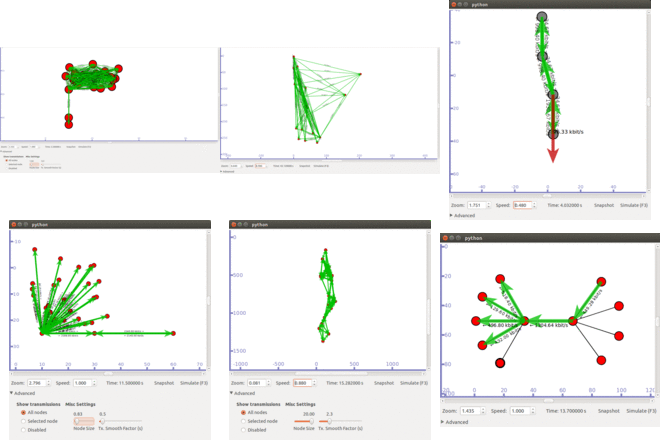 Click Here to watch our latest projects screenshots using NS3 simulator