
How to Implement a Wireless Routing Protocol in NS3
To begin executing a wireless routing protocol using ns3 which needs to model or set up a routing protocol that particularly customized for wireless networks. NS3 has numerous inherent wireless routing protocols like AODV, DSDV, OLSR, and DSR that can be utilized like a basis for the execution. On the other hand, we will need to make a custom wireless routing protocol.
Below is a structured guide on how to implement a wireless routing protocol using NS3:
Steps to Begin Implement a Wireless Routing Protocol in NS3
- Understand Wireless Routing Protocols
- Key Characteristics:
- It is intended for dynamic and frequent mobile wireless networks.
- Address efficient route discovery and maintenance by reason of changing topologies.
- Probably we can utilise proactive routing protocol such as OLSR, reactive like AODV, or hybrid.
- Examples of Wireless Routing Protocols:
- Proactive: DSDV, OLSR which supports to continuously sustain routes.
- Reactive: AODV, DSR that determine the paths on-demand.
- Hybrid: ZRP (Zone Routing Protocol).
- Set Up ns3 Environment
- Install ns3:
git clone https://gitlab.com/nsnam/ns-3-dev.git
cd ns-3-dev
./build.py
- Verify the installation:
./ns3 run hello-simulator
- Plan the Wireless Network Topology
- Components:
- In wireless network, mobile or static nodes are denoting the devices.
- A traffic generator to replicate the data transmission among nodes.
- Topology:
- Make use of mobility patterns for dynamic node placement.
- Describe a Wi-Fi or ad hoc network for interaction.
- Set Up the Wireless Network
- Include Necessary Headers
#include “ns3/core-module.h”
#include “ns3/network-module.h”
#include “ns3/internet-module.h”
#include “ns3/mobility-module.h”
#include “ns3/wifi-module.h”
#include “ns3/aodv-helper.h” // Replace with another protocol helper if needed
#include “ns3/applications-module.h”
- Create Nodes
ns3::NodeContainer nodes;
nodes.Create(10); // Create 10 wireless nodes
- Set Up Mobility
ns3::MobilityHelper mobility;
// Random waypoint mobility model
mobility.SetMobilityModel(“ns3::RandomWaypointMobilityModel”,
“Speed”, ns3::StringValue(“ns3::UniformRandomVariable[Min=5.0|Max=20.0]”),
“Pause”, ns3::StringValue(“ns3::ConstantRandomVariable[Constant=2.0]”),
“PositionAllocator”, ns3::StringValue(“ns3::RandomRectanglePositionAllocator”));
mobility.SetPositionAllocator(“ns3::RandomRectanglePositionAllocator”,
“X”, ns3::StringValue(“ns3::UniformRandomVariable[Min=0.0|Max=500.0]”),
“Y”, ns3::StringValue(“ns3::UniformRandomVariable[Min=0.0|Max=500.0]”));
mobility.Install(nodes);
- Set Up Wi-Fi Communication
ns3::WifiHelper wifi;
wifi.SetStandard(ns3::WIFI_PHY_STANDARD_80211g);
ns3::WifiMacHelper mac;
mac.SetType(“ns3::AdhocWifiMac”);
ns3::WifiPhyHelper phy = ns3::WifiPhyHelper::Default();
phy.SetChannel(ns3::YansWifiChannelHelper::Default().Create());
ns3::NetDeviceContainer devices = wifi.Install(phy, mac, nodes);
- Install the Wireless Routing Protocol
- Using a Built-in Protocol
- AODV Example:
ns3::AodvHelper aodv;
ns3::InternetStackHelper stack;
stack.SetRoutingHelper(aodv); // Use AODV as the routing protocol
stack.Install(nodes);
- Other Protocols: Substitute AodvHelper including:
- OlsrHelper for OLSR.
- DsdvHelper for DSDV.
- DsrHelper for DSR.
- Custom Wireless Routing Protocol
If improving a custom protocol, we can:
- Create a New Routing Class:
- Originate from Ipv4RoutingProtocol.
- Execute the mechanisms such as RouteOutput and RouteInput.
Example Skeleton:
class CustomRoutingProtocol : public ns3::Ipv4RoutingProtocol {
public:
CustomRoutingProtocol() {}
virtual ~CustomRoutingProtocol() {}
Ptr<Ipv4Route> RouteOutput(Ptr<Packet> packet, const Ipv4Header &header,
Ptr<NetDevice> oif, Socket::SocketErrno &sockerr) override {
// Add custom routing logic here
return nullptr;
}
bool RouteInput(Ptr<const Packet> packet, const Ipv4Header &header,
Ptr<const NetDevice> idev, UnicastForwardCallback ucb,
MulticastForwardCallback mcb, LocalDeliverCallback lcb,
ErrorCallback ecb) override {
// Add logic to handle incoming packets
return false;
}
};
- Integrate the Protocol:
- Make a helper for custom protocol.
- We need to install the protocol to utilize InternetStackHelper.
- Assign IP Addresses
ns3::Ipv4AddressHelper address;
address.SetBase(“10.1.1.0”, “255.255.255.0”);
ns3::Ipv4InterfaceContainer interfaces = address.Assign(devices);
- Generate Traffic
UDP Traffic
// UDP Echo server on node 0
ns3::UdpEchoServerHelper echoServer(9);
ns3::ApplicationContainer serverApp = echoServer.Install(nodes.Get(0));
serverApp.Start(ns3::Seconds(1.0));
serverApp.Stop(ns3::Seconds(20.0));
// UDP Echo client on node 9
ns3::UdpEchoClientHelper echoClient(interfaces.GetAddress(0), 9);
echoClient.SetAttribute(“MaxPackets”, ns3::UintegerValue(10));
echoClient.SetAttribute(“Interval”, ns3::TimeValue(ns3::Seconds(1.0)));
echoClient.SetAttribute(“PacketSize”, ns3::UintegerValue(512));
ns3::ApplicationContainer clientApp = echoClient.Install(nodes.Get(9));
clientApp.Start(ns3::Seconds(2.0));
clientApp.Stop(ns3::Seconds(20.0));
- Run the Simulation
ns3::Simulator::Run();
ns3::Simulator::Destroy();
- Analyze Results
Metrics:
- Packet Delivery Ratio (PDR):
- Estimate the percentage of packets that are effectively distributed to entire transmitted packets.
- End-to-End Delay:
- Measure the average delay to attain its end for packets.
- Routing Overhead:
- During the simulation, determine the control messages which are transmitted.
Tracing and Visualization:
- Allow .pcap tracing for packet analysis:
ns3::AsciiTraceHelper ascii;
phy.EnableAsciiAll(ascii.CreateFileStream(“wireless-routing.tr”));
phy.EnablePcapAll(“wireless-routing”);
- Make use of NetAnim for visualization:
./waf –run “wireless-routing-simulation –vis”
- Iterate and Enhance
- Advanced Scenarios:
- Replicate link or node failures for assessing the robustness of protocol.
- Experiment with high mobility to examine flexibility of protocol.
- Traffic Patterns:
- Launch TCP-based traffic or simultaneous data streams.
- Protocol Comparison:
- Experiment the performance of numerous routing protocols like AODV, OLSR in same network conditions.
- Custom Protocol Extensions
- Fine-tune an existing routing protocol such as AODV within src/aodv.
- Prolong the mechanisms with new aspects.
- Recompile ns3 by using:
./waf
With NS3 tool, we executed a detailed implementation approach for executing and examining the Wireless Routing Protocol and we are positioned to expand on the findings as more information becomes available.
 Click Here to watch our latest output video using NS3 simulator
 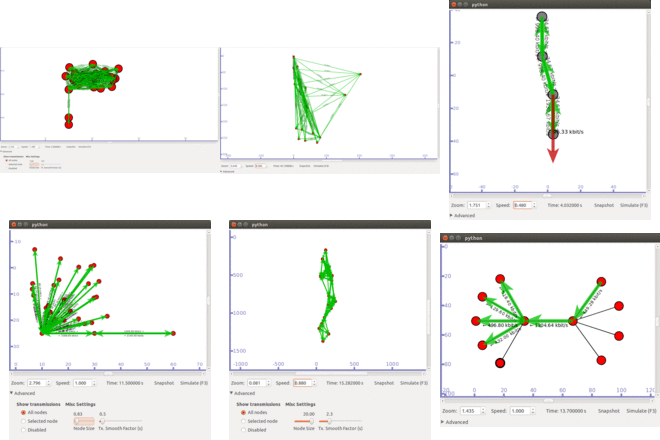 Click Here to watch our latest projects screenshots using NS3 simulator