
How to Begin Implement Content Delivery Network Projects in NS3
To begin performing a Content Delivery Network (CDN) project using NS3, we can replicate the CDN’s distributed architecture for enhancing content delivery and learning their performance. Here’s a sequential mechanism to get started:
Steps to Begin a CDN Projects in NS3
- Understand Content Delivery Networks (CDNs)
Following is significant aspects of a CDN:
- Edge Servers: Located servers deliberately for saving and distributing the cached content.
- Origin Server: The central server presenting the primary content.
- Clients: End-users to demand content.
- Load Balancing: It shares demands to the nearby or least-loaded server.
- Metrics: Estimate the performance parameters such as latency, bandwidth usage, cache hit ratio, and load distribution.
- Define Project Objectives
- Replicate a simple CDN architecture that contains origin and edge servers.
- Evaluate the performance parameters such as latency, throughput, and cache hit ratio.
- Execute aspects like caching, request redirection, and load balancing.
- Install and Set Up NS3
- We should install new version of NS3 on the system.
- Learn about modules such as:
- Point-to-Point: It is designed for wired connections.
- Applications: For client-server interaction.
- Internet Stack: Utilized for IP-based networking.
- Design the CDN Architecture
Key Components:
- Origin Server: Central server to present the original content.
- Edge Servers: To store servers nearer to clients.
- Clients: End-users are demanding the content.
- Communication Links: Interaction links among the origin, edge servers, and clients.
- Implement the Simulation
Step A: Create Nodes
Make nodes for the origin server, edge servers, and clients.
NodeContainer originServer, edgeServers, clients;
originServer.Create(1); // 1 Origin Server
edgeServers.Create(3); // 3 Edge Servers
clients.Create(5); // 5 Clients
Step B: Configure Links
Associate servers and clients to utilize Point-to-Point links.
PointToPointHelper pointToPoint;
pointToPoint.SetDeviceAttribute(“DataRate”, StringValue(“1Gbps”));
pointToPoint.SetChannelAttribute(“Delay”, StringValue(“10ms”));
NetDeviceContainer originToEdge, edgeToClient;
// Connect Origin Server to Edge Servers
for (uint32_t i = 0; i < edgeServers.GetN(); i++) {
originToEdge.Add(pointToPoint.Install(originServer.Get(0), edgeServers.Get(i)));
}
// Connect Edge Servers to Clients
for (uint32_t i = 0; i < clients.GetN(); i++) {
edgeToClient.Add(pointToPoint.Install(edgeServers.Get(i % edgeServers.GetN()), clients.Get(i)));
}
Step C: Install Internet Stack
We should install the Internet stack at every node.
InternetStackHelper stack;
stack.Install(originServer);
stack.Install(edgeServers);
stack.Install(clients);
Ipv4AddressHelper ipv4;
ipv4.SetBase(“10.1.1.0”, “255.255.255.0”);
Ipv4InterfaceContainer originToEdgeInterfaces = ipv4.Assign(originToEdge);
ipv4.SetBase(“10.2.1.0”, “255.255.255.0”);
Ipv4InterfaceContainer edgeToClientInterfaces = ipv4.Assign(edgeToClient);
Step D: Implement CDN Functionality
- Cache Simulation:
- Mimic caching at edge servers to leverage a custom application or a data structure.
- Cache hit/miss logic can execute within a custom Application class.
class CdnEdgeServer : public Application {
// Add custom caching logic here.
};
- Load Balancing:
- Deliver client demands between the edge servers.
- If content is not cached then we can transmit to the origin server.
Step E: Add Traffic Applications
- Install Client Applications:
- Replicate client demands with the support of OnOffApplication.
OnOffHelper onOff(“ns3::UdpSocketFactory”, InetSocketAddress(edgeToClientInterfaces.GetAddress(0), 9));
onOff.SetAttribute(“DataRate”, StringValue(“500Mbps”));
onOff.SetAttribute(“PacketSize”, UintegerValue(1024));
ApplicationContainer clientApps = onOff.Install(clients);
clientApps.Start(Seconds(1.0));
clientApps.Stop(Seconds(10.0));
- Install Server Applications:
- Receive and manage the requests at servers leveraging PacketSink.
PacketSinkHelper packetSink(“ns3::UdpSocketFactory”, InetSocketAddress(Ipv4Address::GetAny(), 9));
ApplicationContainer serverApps = packetSink.Install(edgeServers);
serverApps.Start(Seconds(1.0));
serverApps.Stop(Seconds(10.0));
- Configure Simulation Parameters
Configure the simulation duration and run the simulation by using.
Simulator::Stop(Seconds(15.0));
Simulator::Run();
Simulator::Destroy();
- Evaluate Performance
- Metrics to Analyze:
- Cache hit ratio: Estimate how many demands are functioned from edge servers.
- Latency: Compute delay to deliver requests.
- Load Distribution: Examine the traffic which managed by each server.
- Export Results:
- Record parameters to leverage NS3 logging or create custom scripts.
- Visualization:
- Make use of NetAnim for envisioning request flows.
- Transfer records into external tools such as Python or MATLAB for analysis.
- Advanced Features
- Dynamic Caching:
- Execute content replacement strategies like LRU, LFU.
- Content Popularity:
- Mimic diverse content request models according to the content popularity.
- Hierarchical CDN:
- We will need to integrate regional servers among the origin and edge servers.
- Failure Handling:
- Mimic server or link failures and also assess the retrieval approaches for managing failures.
Sample Complete Code Framework
#include “ns3/core-module.h”
#include “ns3/network-module.h”
#include “ns3/internet-module.h”
#include “ns3/point-to-point-module.h”
#include “ns3/applications-module.h”
using namespace ns3;
int main() {
// Create Nodes
NodeContainer originServer, edgeServers, clients;
originServer.Create(1);
edgeServers.Create(3);
clients.Create(5);
// Configure Links
PointToPointHelper pointToPoint;
pointToPoint.SetDeviceAttribute(“DataRate”, StringValue(“1Gbps”));
pointToPoint.SetChannelAttribute(“Delay”, StringValue(“10ms”));
NetDeviceContainer originToEdge, edgeToClient;
for (uint32_t i = 0; i < edgeServers.GetN(); i++) {
originToEdge.Add(pointToPoint.Install(originServer.Get(0), edgeServers.Get(i)));
}
for (uint32_t i = 0; i < clients.GetN(); i++) {
edgeToClient.Add(pointToPoint.Install(edgeServers.Get(i % edgeServers.GetN()), clients.Get(i)));
}
// Install Internet Stack
InternetStackHelper stack;
stack.Install(originServer);
stack.Install(edgeServers);
stack.Install(clients);
Ipv4AddressHelper ipv4;
ipv4.SetBase(“10.1.1.0”, “255.255.255.0”);
ipv4.Assign(originToEdge);
ipv4.SetBase(“10.2.1.0”, “255.255.255.0”);
ipv4.Assign(edgeToClient);
// Traffic Simulation
OnOffHelper onOff(“ns3::UdpSocketFactory”, InetSocketAddress(Ipv4Address(“10.2.1.1”), 9));
onOff.SetAttribute(“DataRate”, StringValue(“500Mbps”));
onOff.SetAttribute(“PacketSize”, UintegerValue(1024));
ApplicationContainer clientApps = onOff.Install(clients);
clientApps.Start(Seconds(1.0));
clientApps.Stop(Seconds(10.0));
PacketSinkHelper packetSink(“ns3::UdpSocketFactory”, InetSocketAddress(Ipv4Address::GetAny(), 9));
ApplicationContainer serverApps = packetSink.Install(edgeServers);
serverApps.Start(Seconds(1.0));
serverApps.Stop(Seconds(10.0));
// Run Simulation
Simulator::Stop(Seconds(15.0));
Simulator::Run();
Simulator::Destroy();
return 0;
}
We had illustrated the basic implementation process with example coding for Content Delivery Networks projects, executed and analyzed in NS3 environment. Further details will be provided later.
 Click Here to watch our latest output video using NS3 simulator
 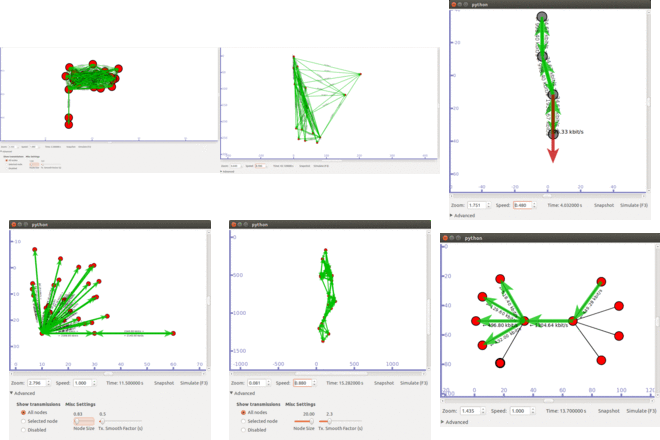 Click Here to watch our latest projects screenshots using NS3 simulator