
How to Begin Implementing a D2D Communication using ns3
To create an execution of Device-to-Device (D2D) Communication project using NS3has been includes their direct communication among the devices deprived of routing congestion by a central base station or main network. This approach is crucial for applications like proximity services, content sharing, and improving the performance of network. Below is a comprehensive guide:
Steps to Begin Implementing a D2D Communication projects using ns3
Step 1: Understand D2D Communication
- Key Concepts:
- D2D Communication: Devices are communicate the directly for cellular or ad-hoc protocols.
- Proximity Services (ProSe): Ensure the communication among near located devices.
- Modes of D2D:
- Underlay Mode: Reclaims the cellular spectrum beside for regular cellular users.
- Overlay Mode: Assigns the dedicated spectrum for D2D communication.
- Use Cases:
- Content sharing for sample video, files.
- Emergency communication in disaster environment.
- Network offloading.
- Performance Metrics:
- It provides the metrices for throughput, latency, interference, and spectrum efficiency.
Step 2: Set Up NS3
- Install NS3:
- Download NS3 from the official website.
- Install required dependencies for instance gcc, Python.
- Enable Cellular Modules:
- Use the components for LTE module it replicate the D2D over LTE.
- Alternatively, use Wifi or Ad-Hoc components for direct communication.
- Verify Installation:
- Validate the environment through processing for sample scripts such as LTE or Wifi examples.
Step 3: Design the D2D Communication System
- Network Components:
- User Equipment (UE): It signifies the devices are capable of D2D communication.
- Base Station (eNodeB): Optionally organizes the resource allocation in underlay mode.
- Communication Model:
- Direct communication among their devices using WiFi-Direct, LTE-D2D, or custom protocols.
- Spectrum Allocation:
- It uses the allocation for cellular spectrum such as LTE-based or unlicensed spectrum like as WiFi-based.
- Mobility Model:
- It replicates the static or dynamic positions using mobility models.
- Traffic Model:
- Describe the kind of congestion such as constant bit rate, file sharing, or video streaming.
Step 4: Implement D2D Communication in NS3
- Create Nodes:
- Use the nodes in NodeContainer for build a UEs or WiFi devices.
- Configure Communication Protocols:
- Designed for LTE:
- Use LteHelper for setting the eNodeBs and UEs.
- Execute the ProSe or sidelink communication for D2D.
- Intended for WiFi:
- Use the WifiHelper for ad-hoc or WiFi-Direct transmission.
- Designed for LTE:
- Spectrum Management:
- Intended for underlay mode, apply the interference management for coexist by cellular users.
- Designed for overlay mode, assign the dedicated spectrum for D2D.
- Install Applications:
- Use OnOffApplication, UdpEchoApplication, or custom applications for replicate the congestion.
Step 5: Simulate and Trace
- Set Simulation Time:
- Describe the replication of duration using Simulator::Stop().
- Enable Tracing:
- It use for ensure of AsciiTrace, PcapTrace, or FlowMonitor fpr log actions of the network.
- Run the Simulation:
- Implement the replication of script using ./waf.
Step 6: Analyze Results
- Performance Metrics:
- It calculates the metrices such as throughput, packet loss, and latency for D2D links.
- Visualize Results:
- Use tools such as Python (Matplotlib) or MATLAB for examine the plot metrics.
- Optimize Parameters:
- Research by spectrum allocation, transmission power, and mobility patterns.
Step 7: Document and Present
- Prepare Documentation:
- Store the simulation setting, configurations, and observations.
- Create Visualizations:
- Use envision for graphs, tables, and charts for avoid the results.
Example NS3 Script for D2D Communication
Here’s an sample of a simple D2D communication setup using WiFi:
#include “ns3/core-module.h”
#include “ns3/network-module.h”
#include “ns3/wifi-module.h”
#include “ns3/internet-module.h”
#include “ns3/mobility-module.h”
#include “ns3/applications-module.h”
using namespace ns3;
int main(int argc, char *argv[]) {
// Step 1: Create nodes
NodeContainer d2dNodes;
d2dNodes.Create(2); // Two devices for D2D communication
// Step 2: Configure WiFi
WifiHelper wifi;
wifi.SetStandard(WIFI_PHY_STANDARD_80211g);
YansWifiChannelHelper channel = YansWifiChannelHelper::Default();
YansWifiPhyHelper phy = YansWifiPhyHelper::Default();
phy.SetChannel(channel.Create());
WifiMacHelper mac;
mac.SetType(“ns3::AdhocWifiMac”);
NetDeviceContainer devices = wifi.Install(phy, mac, d2dNodes);
// Step 3: Set mobility
MobilityHelper mobility;
mobility.SetPositionAllocator(“ns3::GridPositionAllocator”,
“MinX”, DoubleValue(0.0),
“MinY”, DoubleValue(0.0),
“DeltaX”, DoubleValue(10.0),
“DeltaY”, DoubleValue(10.0),
“GridWidth”, UintegerValue(2),
“LayoutType”, StringValue(“RowFirst”));
mobility.SetMobilityModel(“ns3::ConstantPositionMobilityModel”);
mobility.Install(d2dNodes);
// Step 4: Install Internet stack
InternetStackHelper internet;
internet.Install(d2dNodes);
Ipv4AddressHelper ipv4;
ipv4.SetBase(“10.1.1.0”, “255.255.255.0”);
Ipv4InterfaceContainer interfaces = ipv4.Assign(devices);
// Step 5: Create traffic application
UdpEchoServerHelper echoServer(9); // Server on port 9
ApplicationContainer serverApp = echoServer.Install(d2dNodes.Get(1));
serverApp.Start(Seconds(1.0));
serverApp.Stop(Seconds(10.0));
UdpEchoClientHelper echoClient(interfaces.GetAddress(1), 9);
echoClient.SetAttribute(“MaxPackets”, UintegerValue(100));
echoClient.SetAttribute(“Interval”, TimeValue(Seconds(0.1)));
echoClient.SetAttribute(“PacketSize”, UintegerValue(1024));
ApplicationContainer clientApp = echoClient.Install(d2dNodes.Get(0));
clientApp.Start(Seconds(2.0));
clientApp.Stop(Seconds(10.0));
// Step 6: Enable tracing
phy.EnablePcap(“d2d-communication”, devices);
// Step 7: Run simulation
Simulator::Run();
Simulator::Destroy();
return 0;
}
D2D Project Ideas
- Spectrum Efficiency:
- Estimate the effect of underlay and overlay spectrum distribute on cellular and D2D performance.
- Energy-Efficient D2D Communication:
- Execute the energy-aware D2D communication approaches.
- QoS Optimization:
- Analyse on how the D2D communication improves the throughput and latency for detailed applications such as video streaming.
- Relay-Assisted D2D:
- It replicates the D2D communication by relay nodes for encompass the range.
- Security in D2D Communication:
- Study the vulnerabilities in D2D for execute the secure communication protocols.
Here, we had understood how the Device-to-Device (D2D) Communication will perform and emulate the network scenario using the ns3. A dedicated manual will be shared to handle further questions about this project.
 Click Here to watch our latest output video using NS3 simulator
 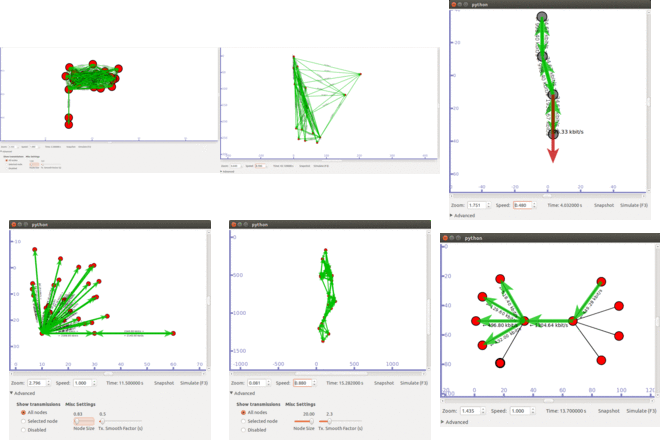 Click Here to watch our latest projects screenshots using NS3 simulator